


























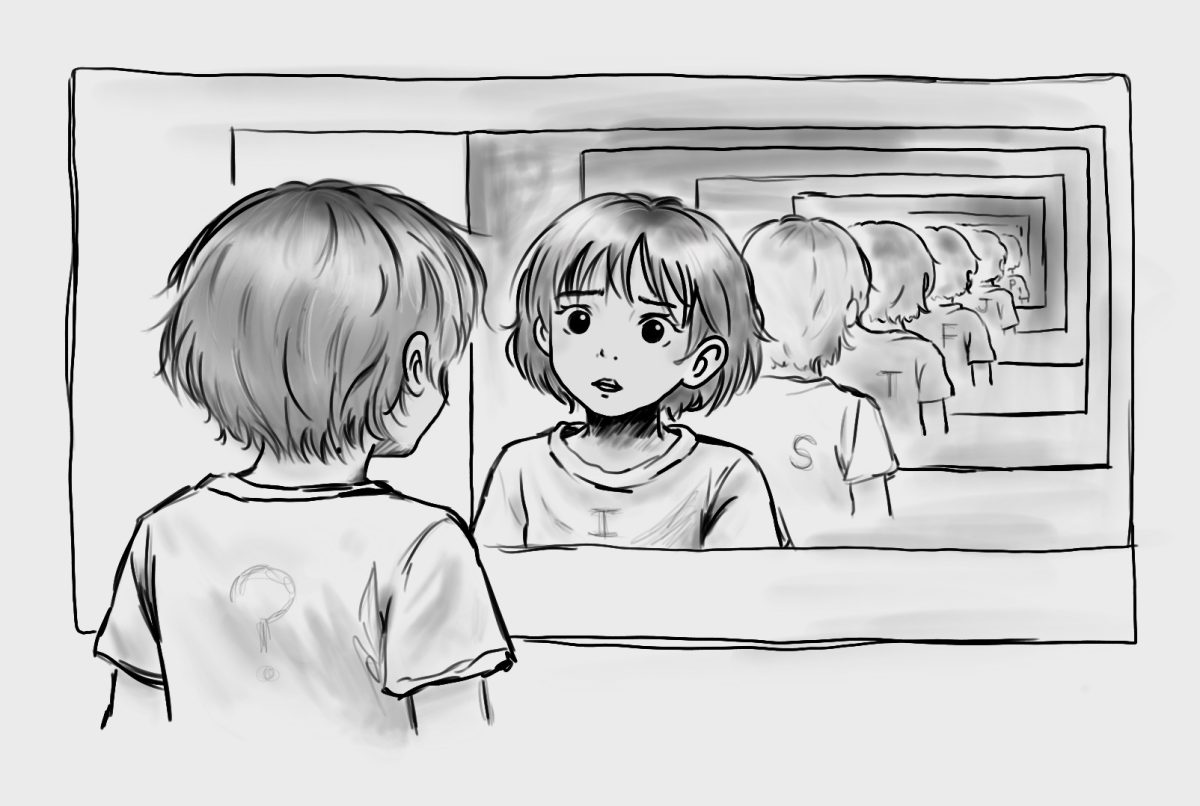
From Korean middle school cafeterias to white-collar break rooms, MBTI results casually roll off the tongue of someone at some point. As near greetings, MBTI labels pepper doses of entertainment and gossip into otherwise bland small talk. “Introverts,” “extroverts,” “F,” other vowels and consonants tossed around as descriptors of an individual – almost involuntarily – have reached the point of becoming its own language. So why is Korea, especially Generation Z, invested in the MBTI? And how can something scientifically weak become socially indispensable?
MBTI lies in disguise: truth surfaces
MBTI stands for Myers-Briggs Type Indicator, a self-report questionnaire that classifies individuals as one of sixteen personality types. It spits out a four-letter combination that is characterized by answering about sixty to hundred Likert-based questions from strongly agree to strongly disagree. Though the questions seem to neutralize the extremes and promise a nuanced outcome, the in-between dissolves into mutual exclusivity.
The answering process weighs disproportionately less than the scoring procedure, where “everything about you” is predetermined by its stubbornness. Following its non-negotiable throughline, individuals fall into one of two dichotomies (pairs of opposing preferences) and as of the unsaid “rule,” one cannot be both: (E)xtroversion or (I)ntroversion, i(N)tuition or (S)ensing, (T)hinking or (F)eeling, and (J)udging or (P)erceiving.
You might consider yourself an extrovert at a family dinner but find yourself an awkward dancer at a party. But the MBTI labels you as either an introvert or an extrovert. You value both spontaneity and structured planning, yet the indicator still places you with one end of the spectrum – judging or perceiving.
The overreliance on these dichotomies delivers a one-dimensional view of the self, forcing individuals into rigid binaries even when traits exist on a continuum, squeezing complex and fluid human traits into sixteen stuffy compartments. The MBTI wanders off from science and into active suspicion.
Boram Park, an assistant manager of sales and marketing in DKSH (Diethelm Keller Siber Hegner), former regional campaign specialist experienced in international healthcare and MBTI-based campaign says, “The MBTI’s rapid rise is tied to a broader shift toward personal preference and self-expression, where people choose products that reflect their tastes, that they stand out. That tendency was always there to some extent, but it feels much more intense now.”
Compared to blood types and star signs, the MBTI contains some psychological elements. Yet, it only mimics science in theory and scientific validity crumbles under its inconsistent outcome. With 50% of participants receiving a different type than their last within a span of 5 weeks, the test proves its inability to measure the longevity of a participant’s personality. While the MBTI aims for an objective result, its self-reported format allows participants to exclude their weakness, removing vulnerability. The lack of a metric to ensure honesty allows participants to easily fake traits and achieve their desired type.
K-MBTI craze in cloudy haste
The MBTI, however, offers comfort to K-Gen Zers living in their hectic Korean society. The success-obsessed culture of Korea prioritizes categorization and intense self-improvement both in school and in the workplace. Many place their excitement in MBTI results to secure success in their performances even though it “demonstrates a predictive success accuracy of up to 30%.”
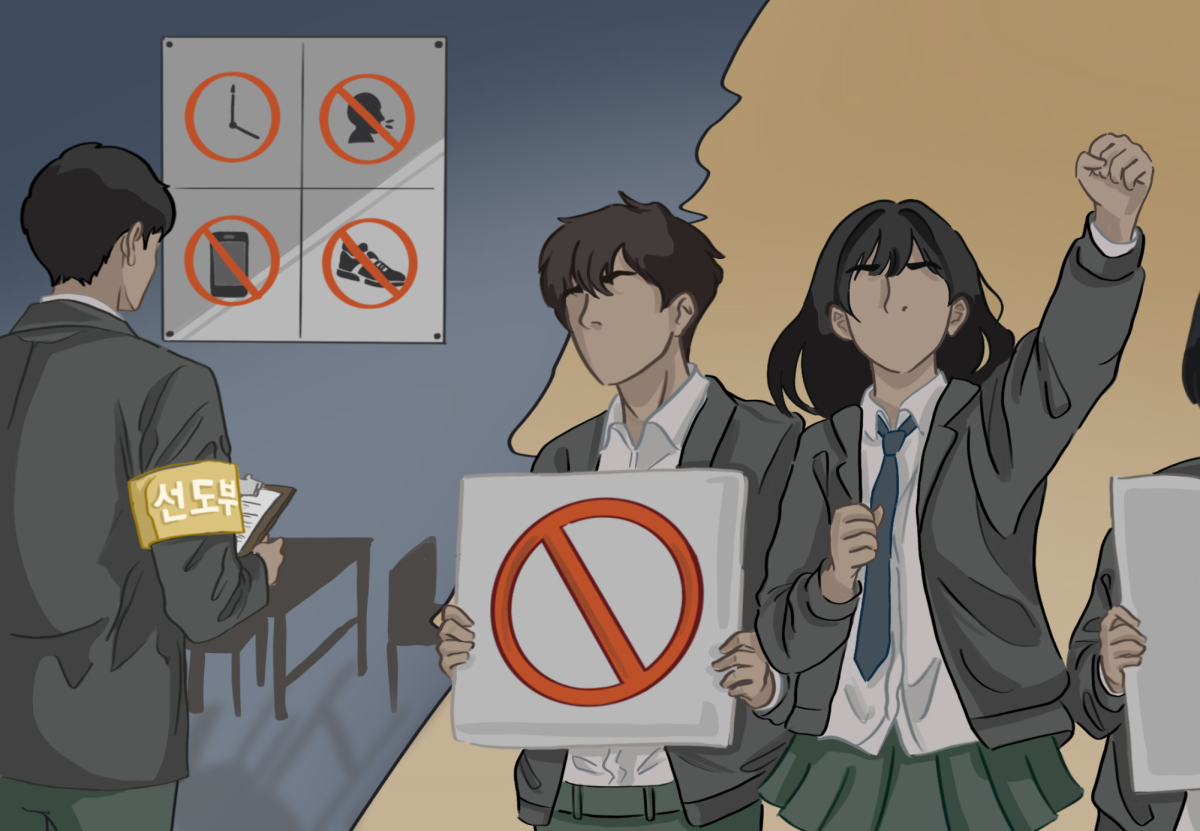
Stores and companies took it as a full-time recruiting method during the height of its popularity in 2022 and still to this day. Optimized for shortcuts, the indicator simplifies self introduction and instead reduces the individual to a mere qualification standard.
While the sociable ones like ENFP and ENFJ “earn” the standard, introverts like INFP and INTJ are strictly prohibited from applying for their presumed “incompetence.”
In this society, speed is a matter of individual competence and success. This constant haste for “time efficiency” and forced adaptation to unfamiliarity arose from Korea’s post-war survival instincts. A compressed modernization and economic growth boomed as rapid reconstruction of the economy was necessary for fast recovery from the war devastation during the 1950s and the 1960s. This period equated incredible productivity with speed – ultimately forming a culture that frames slow progress as fragile.
Putting pride and both advanced physical and digital infrastructures aside, the collective time anxiety grew into a national ideology. With competition hardwired into their consciousness, urgency feels daily. The subconscious tempo of their society encourages low tolerance among Koreans.
As speed translates into services, many, especially K-Gen Zers, when asked to introduce oneself, constantly convey their MBTI type instead of providing thorough explanations. This societal fear of accommodating “waste time” fundamentally limits slow interval trust and heightens immediate identity tied to a pack.
As for K-postmillennials, a digital natives raised on speed, identity no longer exists with internal monologues but rather accepted as a readable label with some singularity for society to consume. Failure to quickly realize one’s identity and personal preference for the benefit of others, results in greater uncertainty in conforming to a “Ppalli-Ppalli (빨리 빨리)” or “hurry hurry” culture. This is where the MBTI comes into play.
The indicator complements the expeditious nature of Korea by providing short intuitive “guesses” that feel generic enough yet narrow – an efficient self-acknowledgement. Park notes, “For people, it’s not really that the MBTI itself is relevant – it’s that interpreting me is what matters. So it becomes like ‘You’re this kind of person, so what about this and that?’ In the end, the message is basically blended into the product [MBTI].” This K-MBTI craze fits the market logic of personalization. Korean society increasingly treats personality and identity like they would for a marketable product. It leaves wriggle room for customization but easy enough to categorize and identify.
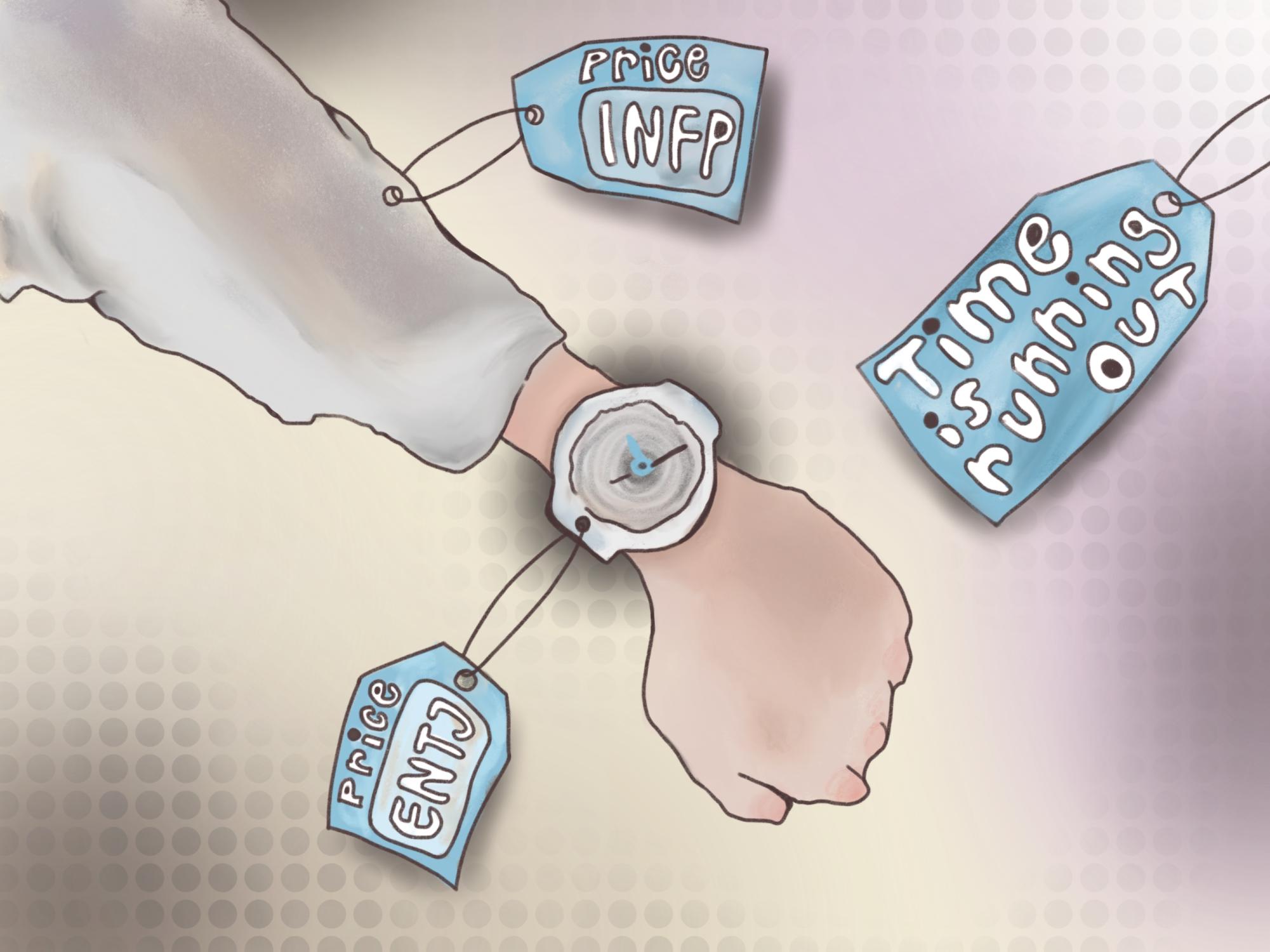
But what is the intrinsic value here? Is it the pleasure of belonging in a pack or is it the performance of belonging? In a time where self discovery and exploration seems like a delay and more like a 15 minute survey, K-Gen Zers feel depleted of real self evaluation. Freshman in Yongshin High School and an MBTI user, Minju Jeong said, “personality is shaped by factors such as one’s upbringing and social environment. Since the MBTI doesn’t have the ‘time’ to take those into account and deliver fixed results, it’s hard to say it’s an accurate measurement for personality.”
Though aware of the murmured criticism and its inaccuracy, the MBTI continues to resonate with this collectivist country with its relative simplicity and convenience. It acts as a shared language and as a sense of camaraderie which generates a form of tribalism. Those not aware of the language are placed in an awkward position.
As a group-oriented culture, Korea puts expectation on an individual’s sacrifice and loyalty for the collective whole. Sometimes, this loyalty appears with a mildly destructive attitude when seeking total authenticity and transparency. “Nunchi culture (눈치),” often referred to as the “guess culture,” operates by indirect cues, including, in this case, the MBTI. Cues are dropped and expected of others to understand without direct questioning.
Stating one’s MBTI type and their designated traits create a mutual understanding between friends, family, and even strangers. Jeong further explains that there is an unspoken responsibility in justifying your personality, in Korean, ’해명 (haemyeong),’ “Every now and then, there are some people who can come off a bit harsh. They’ll pause and say ‘Sorry, I’m a T, so I might say things in a blunt manner. I don’t mean to offend you.’ I think they try to avoid any kind of misunderstanding – to be understood clearly. But many still live with the mindset that it’s fine if they don’t fully understand me.” These portable, compressed ‘personality zip files’ become practically installed into their system and lifestyle.
A Love drought: Gen Z wants to be understood ASAP
“Time efficiency” applies to dating and love life for K-postmillennials. Matchmaking prioritizes productive dates meaning a romantic bond must flare at first sight. Dating bios are less about the individuals but rather the glorification of one’s MBTI profile. Being matched with a type that suits your MBTI type, equates to success achieved through efficient time management.
Mainstream media also obsesses over efficient partnership as Korean reality dating shows like ‘I am Solo’ popularized personality-based compatibility as a common interest for ‘sogeting (blind dating)’ during 2024. What was once considered a source of entertainment now blinds love. Park continues,”Yet even if it’s (MBTI) not entirely rational, marketing ultimately has no choice but to step into the flow of the consumers’ wants.”
The MBTI filters out potential “icks,” red flags, and ranks compatibility with a potential partner. Popular Korean dating apps such as ‘Glam (글램),’ and ‘ENFPY (엔프피),’ goes by plain vibes and MBTI type alignment which feels counterintuitive to the sincere pursuit of love.
The name ‘ENFPY’ already suggests some supremacy and bias towards the more “socialized” trait ENFP, as the app labels ‘Y’ next to the date-able traits; other traits are easily dismissed and looked down upon. ‘ENFPY’ also charges a 7-10 dollar additional fee to unlock real conversations and a deeper dive into their partners’ interests. Almost in sync, ‘Glam’ mirrors ‘ENFPY’ with its efficient use of the MBTI. According to the app’s designer, the brand aims to fully “satisfy the desire of love” with purchased compatibility.
Long term relationships should not be confined to the alignment of two MBTI types. MBTI type matching happens in a matter of minutes without a face to face confrontation, exactly what Korean society prizes: efficiency. To K-Gen Zers, Korea’s systemized dating practices creates unnecessary barriers, where idealism overrides realism. By eliminating unfavorable, risky types specific to the individual and choosing only what seems like “compatible” types, they appear liberated from failure – the failure to rest in the arms of their dreamt soulmate. With the growing obsession of finding a sanitized love, MBTI profile becomes a romantic necessity.
Although efficient, low-conflict love means less exposure to emotional friction – an essential element to slow, mature love. Since a person of any MBTI type can exhibit both healthy and toxic behaviors, a four letter code is insufficient to conclude someone or claim they pair well with a certain type. Is an elusive question always in need of a definite answer?
The unstable nature of the MBTI cannot capture the entirety of the person, only the probability that this person “might be” or “could be” a prince charming or a sobering presence; an illusion that you know this person better than they do themselves. Park says, “In the past, it was blood types; before that was zodiac signs; and even before that was saju (four pillars of destiny). When you consider all this, dividing people into just sixteen types doesn’t really make any logical sense.”
Layers of offline human contact now dissipate with the digital age and the past quarantine era. This gradual removal of patience and slowness also shortens quality time spent with a partner or with a social group. Going increasingly digital, the “Ppalli-Ppalli” culture subconsciously imbues these postmillennials as screens replace time and bridging the physical and digital world becomes much harder. As scrolling accelerates, genuine connection loses direction and becomes evermore fleeting.
MBTI type provides the best result when Gen-Zers need to hurriedly analyse and understand others, however surface-leveled that information may be. So are we forming genuine connections or just performing them? Well, as of the current love trend in Korea, not only does love feel rushed but sincerity also carries a deadline. A deadline invisible to the eye of K-Gen Zers but just visible enough for their minds to watch it pulsate unnecessarily faster.
Conclusion
Along with the convenience of the MBTI, fear invades the minds of K-Gen Zers. Their tendency to avoid risks and uncertainty at all costs only raises more concerns on how to thrive in a fast-paced world submerged in uncertainty. Can there be real intimacy if speed is the sole metric when it comes down to understanding a society, a generation, a person, and something so abstract as love?
There are certainly merits in Korea’s fast waltz as efficiency almost always guarantees quick results. But these results tragically lack depth – a time-based foundation. A flawless pair, a flawless anything rarely exists as these imperfections disclose our shared struggles in striving for perfectionism.
Four letters might help you cope with this frantic world efficiently and temporarily, but as Park says, “The MBTI appears to be merely part of a broader social current.” Humanity is the cumulative outcome and continuous contemplation of time – something the MBTI cannot measure and something we, as humans, must persevere by tolerating uncertainty and contradiction.




AnnaBanana • Mar 26, 2026 at 5:46 am
I like your nice details on the pictures, it looks like that you’ve put a lot of work into them.
Irene • Jan 22, 2026 at 6:26 pm
I love this article because it has so much thought and detail. Great job, Agnew!
Allison • Jan 22, 2026 at 6:24 pm
wow my mbti is infp