








































*Editor’s Note: The Jets Flyover Editorial Board has chosen to keep A*, a former student gambler, anonymous due to concerns about potential legal repercussions. All references are marked with an asterisk.
4,715. That’s the number of teens that an online task force found guilty of illegal gambling. These numbers represent the sinister truth behind South Korea’s disciplined and academically driven youth culture: underage gambling.
On a broader look, some estimate the domestic illegal betting market at nearly 96 trillion won, with the youth participation rate accounting for around 4% of all activity. These statistics reveal more than isolated incidents; they reflect the surge of a social issue that exposes the nation’s insufficient regulation and protection for adolescents.
More concerningly, the average age of participation continues to drop. Some studies now identify the fifth grade of elementary school as the most common point of entry to gambling. As younger students become exposed to these platforms, psychological manipulation and addictive behavior begin to fester at earlier stages of development.
Yet perhaps the most alarming fact is that many teenagers recognize the criminality of the dangerous rituals. From online lotteries, casinos, card mini games, and sports bets, cyber gambling no longer remains hidden as an underground activity. It got embedded as a pervasive youth culture, and adults have only begun to see the surface of its severity.
Insufficient regulations
Current regulations fail to keep up with this proliferation. Although South Korea strictly outlaws gambling for students, adolescents continue to seek illegal activity through unapproved websites and PC rooms. Cyber platforms prove especially challenging to regulate, since they operate outside Korean jurisdiction. This makes any form of national intervention difficult, contributing to online bets now constituting about 84.8% of all cases.
What’s more, most teens access these platforms through mobile phones or at secluded PC rooms, which makes enforcement nearly impossible. “I don’t see illegal gambling that often, but when I do, I’m always at a loss on how to deal with it,” Gang Dae-won said, a PC bang owner. “I don’t know if I should report it, tell them to stop, or something else. Normally, I end up leaving them alone, because I don’t want to get in trouble myself.”
Despite the evident inadequacy in prevention measures, authorities still hesitate to crack down on portals due to high monetary costs. This creates a dangerous conception among students: that they will never receive punishment, which paves the way for illegal website hosts to further their influence. And through a variety of ways, service providers succeeded in that regard.
The advertisement pipeline
Advertisements further accelerate this phenomenon. According to the Seoul Economic Daily, over half of Korean teens reported that they witnessed gambling advertisements through social media, text messages, pop-up ads, and internet banners. Most adolescents do not actively search for gambling opportunities, but instead, betting platforms search for them.
Such repeated exposure and high accessibility attract curious students into the trap, which subconsciously normalizes the behavior and often leads to addiction. “I think I first came across gambling because I saw an advertisement when browsing on the internet,” A* said, a former student gambler. “I ignored it at first, but after seeing it again and again, I decided to see what it was about.”
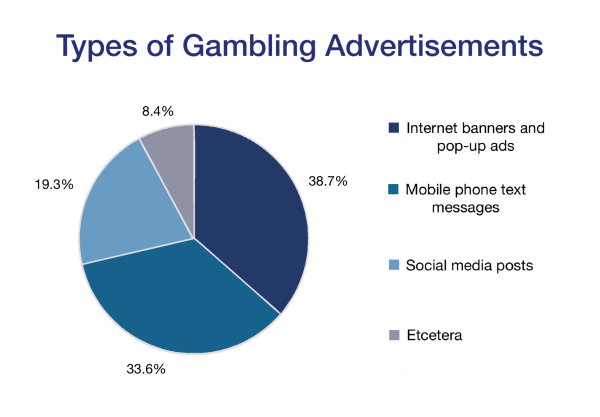
This phenomenon becomes further exacerbated when one considers the countless number of influencers and online celebrities, viewed by teens, showcasing big wins, further encouraging youths to engage in gambling. One fact proves clear from the data. Operators deliberately target adolescents, more likely to watch and become influenced by these streamers.
The hijacked adolescent mind
The exponential rise in gambling cases among Korean youth extends beyond unwise choices and aggressive promotions. It reflects a deeper form of psychological manipulation with the potential of prolonged harm.
The brain’s prefrontal cortex, the region responsible for impulse control and evaluation of long-term consequences, continues to develop until the mid-twenties. As a result, teenagers stand more susceptible to the compulsion of immediate rewards, which gambling directly yields.
Sports wagers, in particular, stand out as one of the most addictive forms because they create an illusion that success depends more on skill than chance. “I would always analyze K-League matches to see if I could predict the next game’s results,” A* said. “It didn’t feel like luck because there was data that could be analyzed, and using statistics, you could be convinced that it’s more analytical than random…it’s the illusion of control that gets you.”
Even outside sports gambling, the more prolonged the activity continues, the harder it becomes for students to shatter the loop. “Even outside of sports gambling, it still feels addictive. Whenever I just barely lost, I would be compelled to try again, because I thought to myself that I would definitely win if I tried again,” A* said.
The activity also spread rapidly across peer groups. According to recent data, 40.3% of teenagers first encountered gambling through friends. As adolescents share these platforms with one another, gambling transforms from an independent activity into a collective phenomenon.
Despite this, due to the vulnerabilities in the brain, underage involvement in high-risk bets rages beneath the public eye. The combination of psychological vulnerability, unregulated digital access, and social exposure leaves students susceptible to manipulation.
High stakes
The issue goes far beyond psychological dependency. Gambling increasingly places a serious financial burden on youths, with average losses at 780,000 won per person in 2024. In one extreme case, a high schooler spent a total of 190 million won on games of chance. These numbers highlight the thin line between entertainment and financial devastation.
The consequences soon extend beyond financial loss. Some desperate students attempt to recover their gambling debts through illegal loans carrying exorbitant interest rates. Others even resort to second-hand crime like theft or fraud after losses accumulate unmanageably. “One time, I saw some high schoolers talking about how to make up for their casino losses, talking about stealing,” Gang said. “I went and told them that it was wrong, but it makes me wonder how many actually commit those crimes.”
At the same time, those found guilty face harsh punishments and social condemnation. Offenders face fines of up to 10 million won, with imprisonment for 3 years or a fine of 20 million won for habitual criminals over age 14. And beyond judicial penalties, heavy ostracism awaits them in a society that strongly values moral conformity.
However, this raises a broader contradiction, as those most susceptible to psychological manipulation face the heaviest condemnation – even more than illegal operators who deliberately exploit these channels. Teenagers undoubtedly deserve punishments for offenses, but the structure that enables widespread online gambling stands imperative.
Needed action
As the issue mainly stems from the lack of prevention and regulation, the government should impose harsher punishments and stricter restrictions on service providers, especially those who function within South Korea. Simultaneously, schools should implement effective education on the psychology of gambling and the associated high risks.
Many remain unaware of public support systems, like the 1336 gambling addiction helpline that provides information on local support groups. Community-wide support for greater awareness of the dangers of gambling and available help, not solely punishments, stand crucial.
Ultimately, the problem doesn’t lie only with the kids. It lies in the lack of regulations on cyber bets and insufficient support available after they fall into the cycle of addiction. Given the severe psychological and financial damage associated with gambling, lawmakers must work to strengthen prevention, regulation, and recovery measures to eradicate the destructive trend.





Muhammad Mukhammad Khorilov • May 14, 2026 at 7:33 pm
Gambler’s mindset:
“If I stop gambling, I will never win!”