












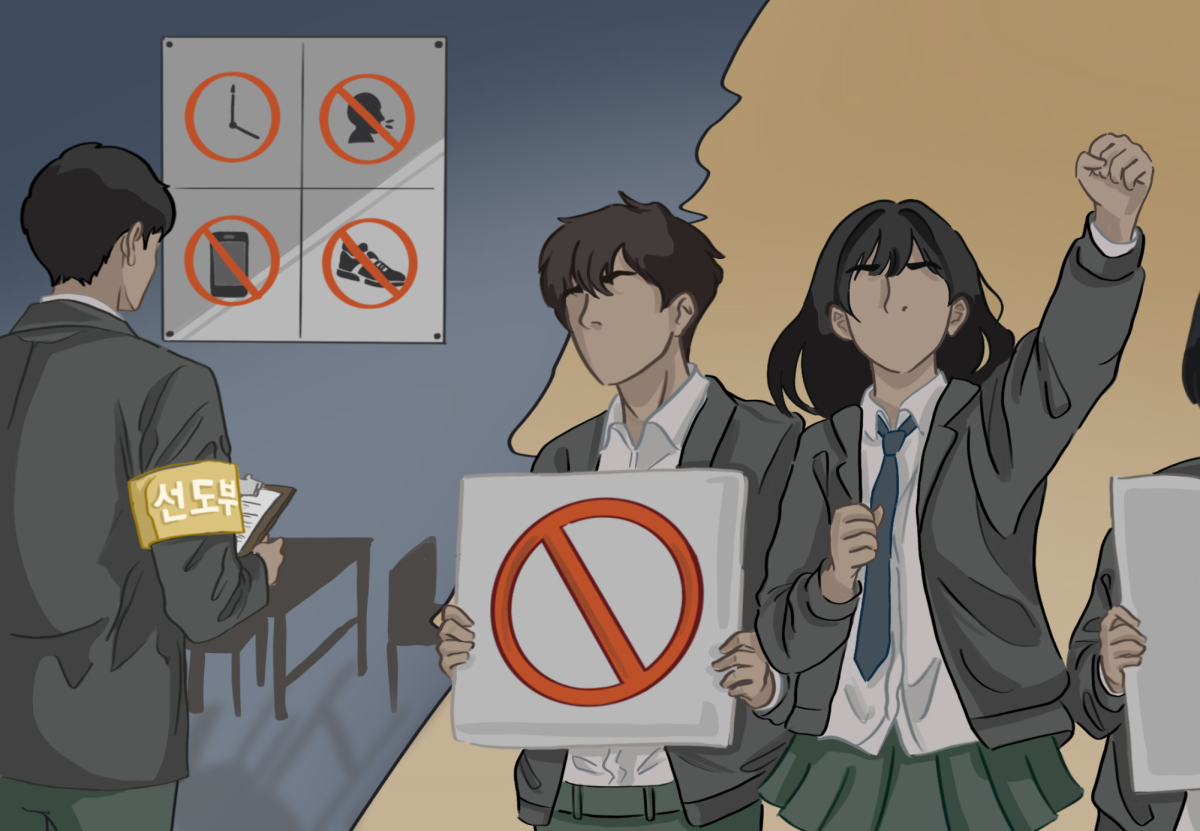























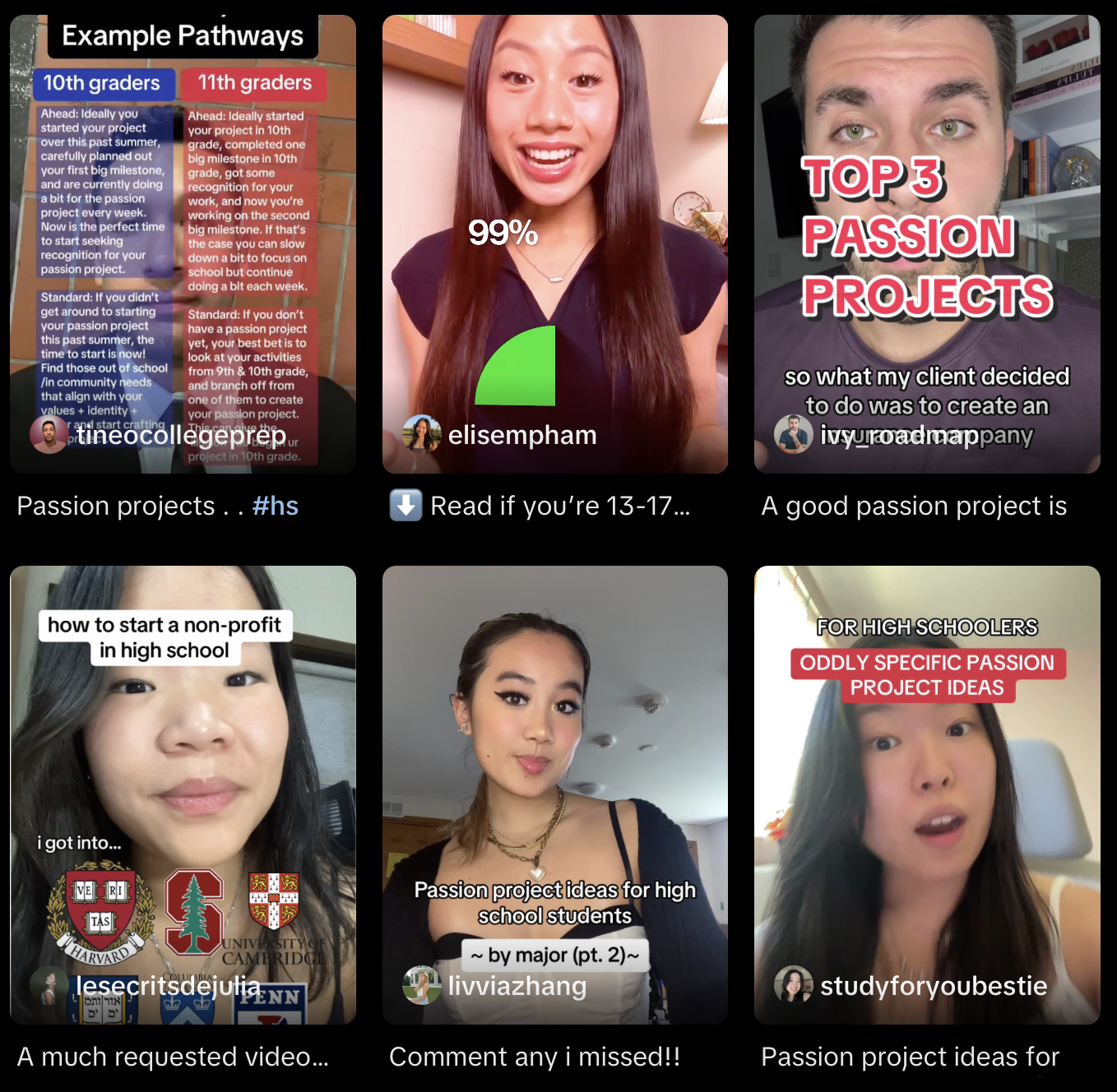
“Comment ‘PROJECT’ to get my ultimate list I use with my students to make sure their projects are elite and on track to get into an Ivy League School.” Variations of this pitch flood college admissions feeds, where the hashtag #passionproject began to frame extracurricular activities less as original interest and more as currency to buy a one-way ticket to a top college.
Passion projects initially aimed to cultivate interpersonal development through self-initiated pursuits that explore an area of interest outside of the limited school curriculum. Students create school clubs, code games, and launch non-profits that address real-world challenges from climate change to racial inequality.
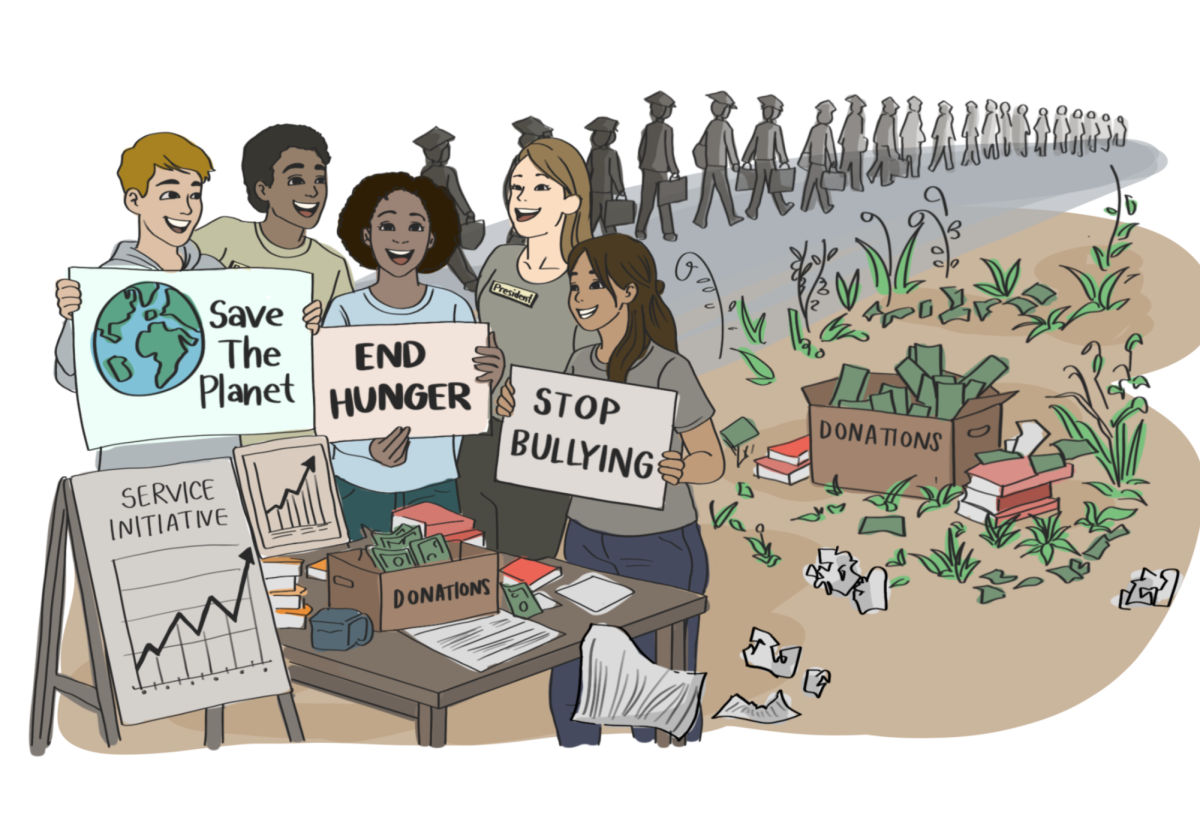
Yet, as current application trends head towards depth over breadth, passion projects have deteriorated into another checklist item that curates a marketable persona on resumes. Interpersonal development and growth become time-bound, with an expiration date each year in March as high school seniors receive their college acceptance letters.
The ‘availability cascade’ — where social media increases exposure to high-profile exceptions and forms new norms — created an illusion that sixteen-year-old students must spearhead the development of a corporation or change the world through non-profit work to succeed in the college admission process.
The expectation to build world-changing impact alters how students define adequacy. Junior Flora Yoon said, “Especially going up to junior year, I’ve seen a lot of my friends making clubs, having all these leadership roles, and becoming a ‘founder’…I felt I wasn’t living up to the expectations around me…with the big pressure of college, I felt I was falling behind.”
Under this pressure, students funnel into the well-trodden track to become a “founder” of another non-profit or an executive director of another initiative disguised as passion. As the growing trend frames leadership as a prerequisite for formulaic success, meaningful participation carries less perceived value than superficial ownership.
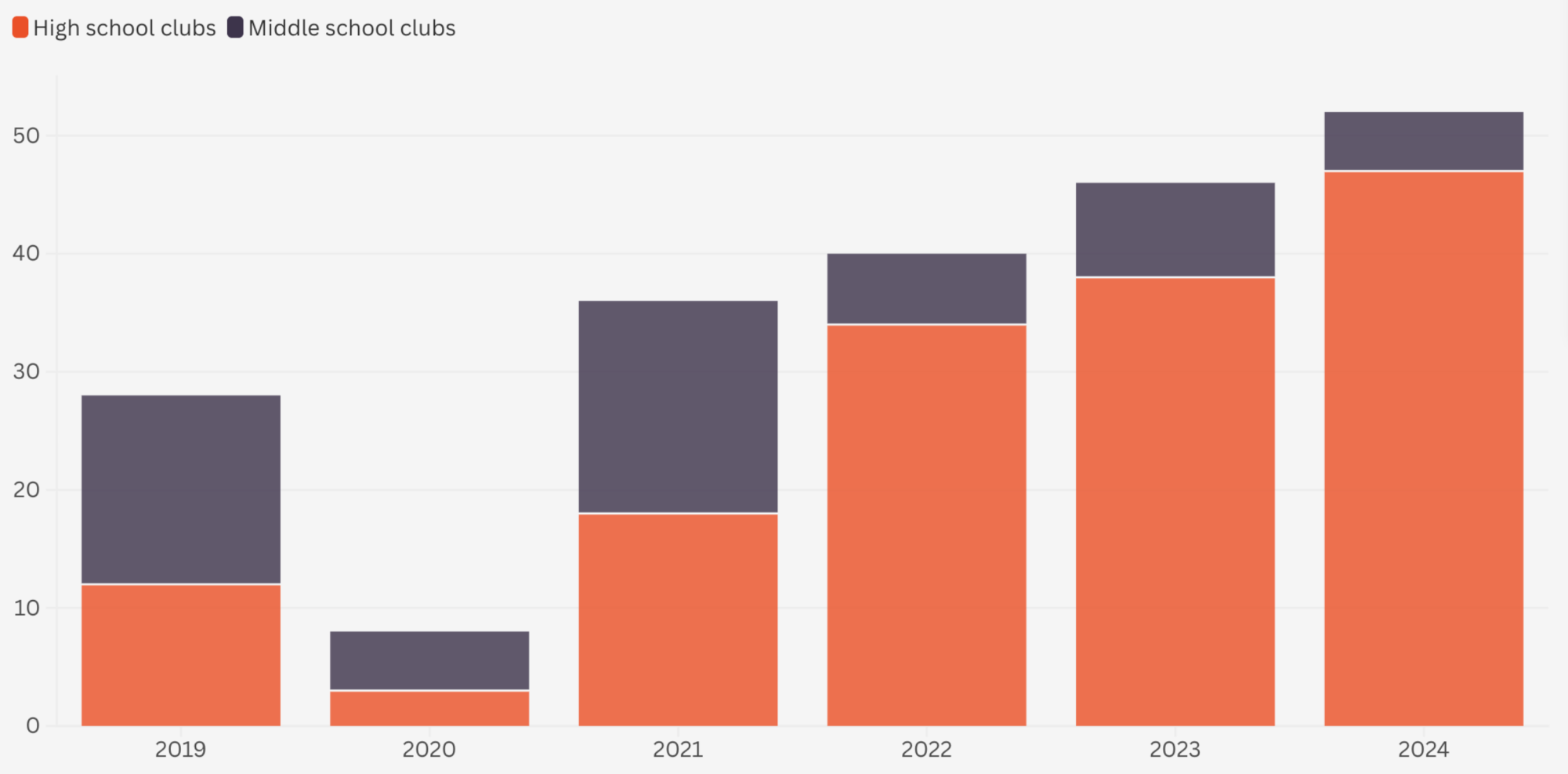
On paper, the one-to-one ratio of leaders and peers suggests a thriving culture of student leadership. In practice, however, it reflects a narrowed definition of what meaningful involvement looks like.
Selina Son, a 2025 alumna who co-founded SOAR (Student Organization Against Racism), said, “Everyone tends to think like ‘I need to start a club,’ but it’s not whether you founded [a club] or not. It’s just the leadership that comes naturally if you spend a lot of time on it…even if I wasn’t one of the founding members, I would have still joined and I would have still pursued that project…I loved doing the planning, and I still love everything.
Son notes that students often overestimate the value of starting something new while underestimating the growth that comes from sustained involvement. “Of course, it looks nice if you founded a club. But I don’t think the admissions officers are looking at how many clubs you founded. It’s all about growth.”
Yet, repeated examples of high-profile founders harden into an informal benchmark. Even without explicit instruction, students begin to identify leadership titles and non-profits as a signal of ambition. Nayoung Kim, former president of environmental clubs Eco-lution and Greenpeace at DIS, echoed how the difference between authentic engagement and performative passion reveals itself over time. “Whenever someone does follow a ‘passion’ in a very superficial way, you can tell they’re not involved as much, and they’re trying to do things just to show that they did something. Not because they created change that stemmed from genuine interest,” Kim said.
The problems lie in the admissions ecosystem that misleads students to confuse passion with presentation. Founder titles, visibility, and scalability become the markers for “impact,” and projects shift from opportunities for personal evolution to a disposable tool of evaluation. College counselor Mrs. Jolly reflected on her experience. “I noticed that students feel like they have to do all the things…But I think that if you are truly passionate about what you’re doing, it’s going to be obvious…If you leave, if you don’t come to school tomorrow, would anyone notice? That’s what it comes down to,” said Mrs. Jolly.
The distortion lies less in what colleges formally require, but more in the interpretive nature of those requirements. Especially in highly competitive environments where constant peer comparison looms, perception quickly hardens into a new standard. A couple of founder titles and nonprofits in a social environment where students rationally respond to the new norm that presents impact concisely.
In reality, admissions officers do not tally the number of clubs a student launches, but the depth of engagement within them. Impact is rarely defined by initiative alone, but by sustained effort and the actions taken within the project. When structured around growth rather than visibility, student projects function as early civic training grounds. Students learn to apply ethical reasoning within real organizations, and skills that students can carry forward. Those competencies—unlike titles or timelines—do not expire into resume artifacts.
Son shared how her current academic path applies the skills she first gained through her deep involvement with SOAR. “I’m currently pursuing biology and anthropology, which is called the Global Health and Environment (GHE) track…and it’s focused on how we can overcome our ethnocentrism…And a lot of those practices of acknowledging that my perspective is not maybe the perspective that everyone holds…having that understanding is built from SOAR’s core values,” said Son.
Kim similarly explained how her experiences manifest in her political science and criminology majors. “How I stand my passion for everything from Eco-lution, Greenpeace, to broadcasting is like having a key. Speaking out for people and my major in criminology and political science, since I want to be a lawyer.”
Kim further highlighted the long-term value of authentic involvement.
The incentives that shape high school involvement are unlikely to disappear. As long as the admissions process condenses growth into one or two sentences that show visible impact, students will continue to make themselves legible on paper. Yet, especially when pressure reduces success into an end goal, high school students must continue toil—as suggested by the Latin definition of passion, “to endure”—to find what makes us distinctive and follow our own path apart from the newest admission trends.