













































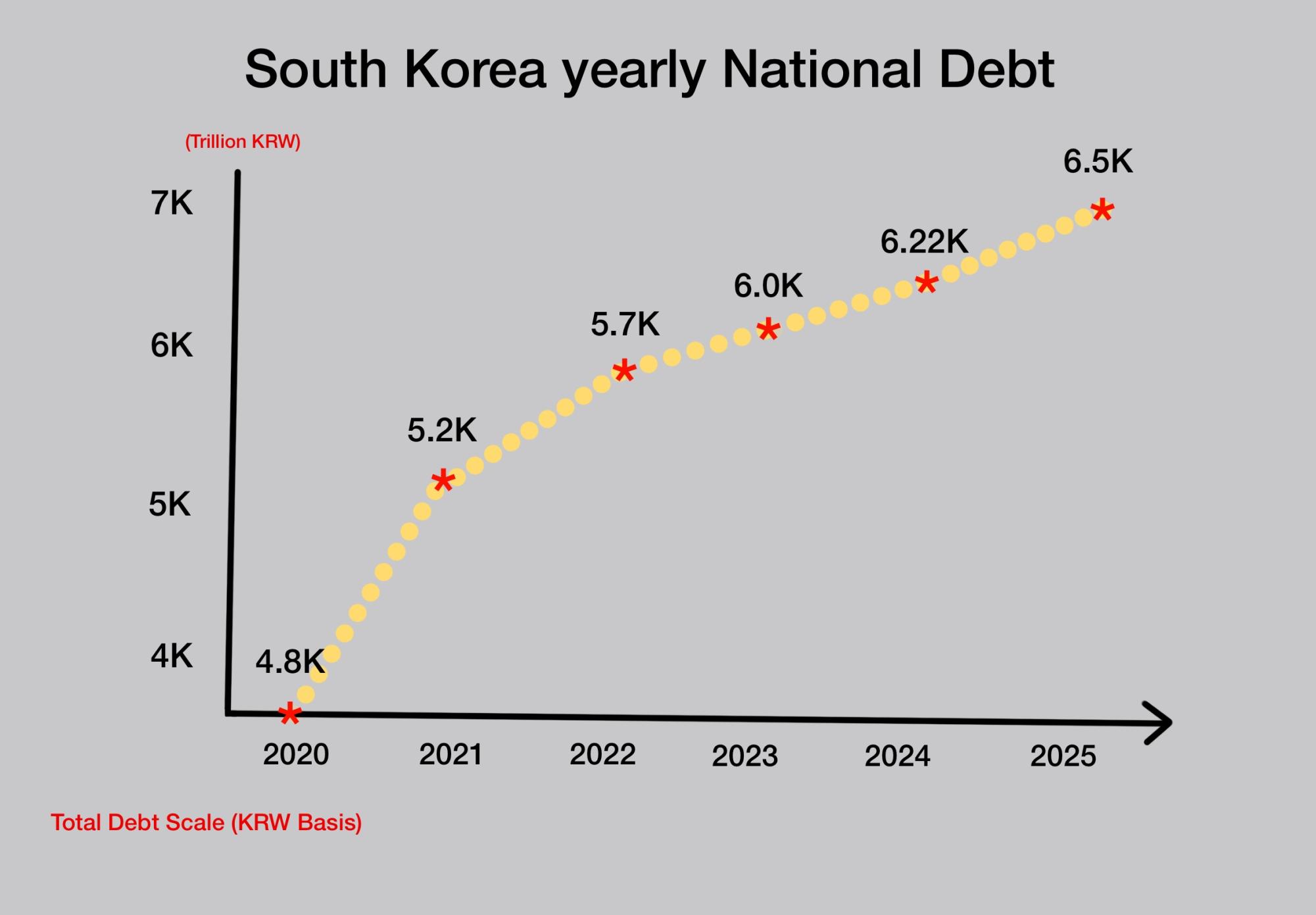
On the floor of the Congress Assembly, President Lee announced a supplementary budget in early April 2026 – an additional financial plan used to revise government spending midyear. Alongside the announcement, the Korean government revealed that Korea’s national debt reached a record 13.9 trillion won, near half of the country’s Gross Domestic Product (GDP).
Currently, debt per citizen exceeds 20 million won, which reflects concerns about Korea’s growing financial burden. As government debt further accumulates, worries regarding long-term repayment obligations and the strain placed on future taxpayers rise as well.
Part of the expansion in spending involves necessary government action. Korea faces a severe demographic crisis with a low fertility rate, population decline, and rapid aging. In response, the government expanded pensions, healthcare programs, and elderly welfare systems to support vulnerable groups and encourage childbirth.
However, government spending no longer concentrates primarily on essential welfare. In recent years, the government has introduced multiple rounds of livelihood support funds of up to 600,000 won per individual to stimulate spending and ease financial burden. The government also increased spending on industrial and development projects, demanding more money to borrow.
These policies provide short-term relief, but they also deepen long-term pressure. Each round of subsidies contributes more to the total debt that future taxpayers must eventually repay.
The concern lies not only in the amount of debt itself, but in the speed of its growth. Korea currently has the fastest-growing government debt among countries without reserve currencies. Unlike nations such as the United States, which maintain global demand for their currencies despite large deficits, Korea can’t borrow endlessly without risking currency depreciation and inflation.
The problem intensifies because Korea is already weighed down by intensely high household debt and rising interest rates. As the government borrows immense amounts, it advances the demand for loanable funds, which instigates higher interest rates. This rise could result in reduced business spending that, in turn, stunts job creation, consumer spending, and ultimately economic growth.
Although this problem is pervasive around the world, countries like the U.S. have stronger consumer markets and global financial influence. In contrast, Korea’s economy stands comparatively vulnerable to shocks in real estate, exports, and currency markets.
Citizens directly feel the impact. Higher interest rates increase the cost of mortgages, student loans, and business investments, while inflation raises the price of food, transportation, and education. Families face greater burden despite the very policies designed to reduce financial pressure.
Young people will likely absorb the greatest damage. As national debt accumulates, future workers may face higher taxes, weaker job markets, and difficulty earning independence. Specifically, home ownership and entrepreneurship become harder to achieve under exorbitant interest rates.
Economics student Jeong-sae Kim highlighted this counterproductive effect. “Welfare and economic stimulus are important, but in the end, the burden is likely to fall on future generations. While government support policies may help in the short term, what matters more fundamentally is the availability of stable jobs and affordable housing,” said Kim.
Heavy debt also weakens the government’s ability to act in future crisis. During another recession, Korea may lack the financial capacity necessary to spend more and stabilize the economy. Policies designed to expand opportunity for citizens could ultimately reduce the flexibility to protect them in the future.
To prevent that outcome, the government must reassess its spending priorities. Authorities should eliminate inefficient public institutions, cut wasteful budgets and reevaluate large-scale agendas with uncertain long-term gains. Reforms in social insurance systems, such as pensions and health insurance, can also minimize future fiscal burdens.
Ultimately, expenditure intended to support those in need actually placed a more long-lasting burden alongside high interest rates and inflation. Without strategic fiscal restraint and long-term reforms, the nation risks carrying these challenges into the future.






Mr Purdy • May 28, 2026 at 7:30 pm
What an insightful and thought provoking article! It brilliantly highlights the complex dynamics of government spending, national debt, and their long term impacts on Korea’s economy and future generations. The detailed analysis and clear explanations make it both engaging and educational. I will be thinking about finances all day now. Thank you.