



















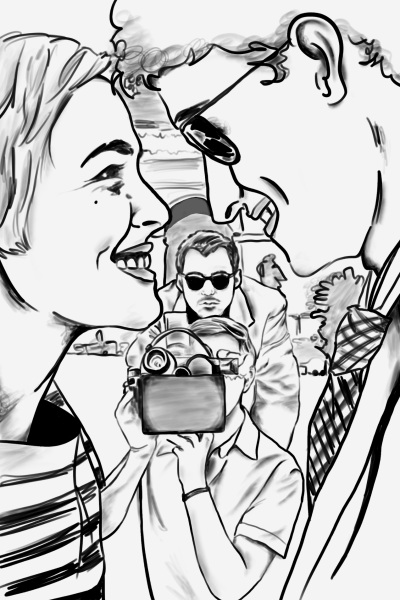
Despite the film industry’s appetite towards large-scale formulaic content, cinephiles continue to crave sincerity. To that, Richard Linklater presents a quiet rebuttal to cinema’s authenticity deficit through an unhurried, nonlinear narrative that unfolds like a cozy fever dream. Through Linklater’s rose-colored lens, ”Nouvelle Vague” navigates the reasons we fell in love with cinema in the first place: the thrill of experimentation, artistic wonders and the stubborn impulse to create, even when the world is against it.
As an ode to the radical French New Wave and Jean-Luc Godard, a beloved and reviled French auteur of the post-war era, Nouvelle invigorates Godard’s contagious passion for filmmaking and his non-negotiable, uncompromising conviction.
Richard Linklater, a self-taught writer-director, best known for the Before Trilogy, dramatizes the making of Godard’s directorial debut, “Breathless” (À bout de souffle), a classic landmark of the French New Wave. Set in Paris in 1959, “Nouvelle Vague” celebrates the inception of the French New Wave, fueled by the young critics and insurgents at Cahiers du Cinéma: François Truffaut, Claude Chabrol, Eric Rohmer, Jacques Rivette and Godard himself. Inspired by Italian neorealism, they sought to reject the predictable and traditional studio-bound cinema by redefining the cinematic status quo with experimental and avant-garde cinema.
Cinema in the 1950s prioritized control and marketability, with profit dictating production decisions. With studios tightly managing production and limiting directors’ creative authority, cinema became manufactured products aimed at mass appeal, losing its defiant artistic voice. Therefore, in refusal of commercialism and conformity within mainstream cinema, Godard pushed for a feature in pursuit of conscious filmmaking, as many of his fellow writers of Cahier du Cinéma had already set forth to do.
Godard convinces Georges de Beauregard, a rather conservative producer, to finance his low-budget film “Breathless” co-written with his friend, critic and experienced filmmaker François Traffaut. Regarding the cast, Godard approached Jean-Paul Belmondo, an old collaborator of his, for the role of a thief. He also phoned American movie star Jean Seberg for the role of a career-driven woman who personifies modern femininity, antithetical to the conventional femme fatale archetypes Hollywood initially assigned her.
Under Godard’s directing, the production of “Breathless” rejected large studio sets and high budgets. Takes were kept to a minimum without grand lighting or a complete script and handheld cameras replaced stable filming. Godard abandoned conventional methods, favoring immediacy and improvisation over staged performance.
He sought to animate cinema through his own brand of neorealism that embraced the imperfections of real life, something absent from mainstream cinema at the time. Yet his youthful rebellion and insistence on a purely creative vision clashed with Beauregard and Seberg, who grew increasingly impatient with Godard’s directorial choices and even threatened to quit.
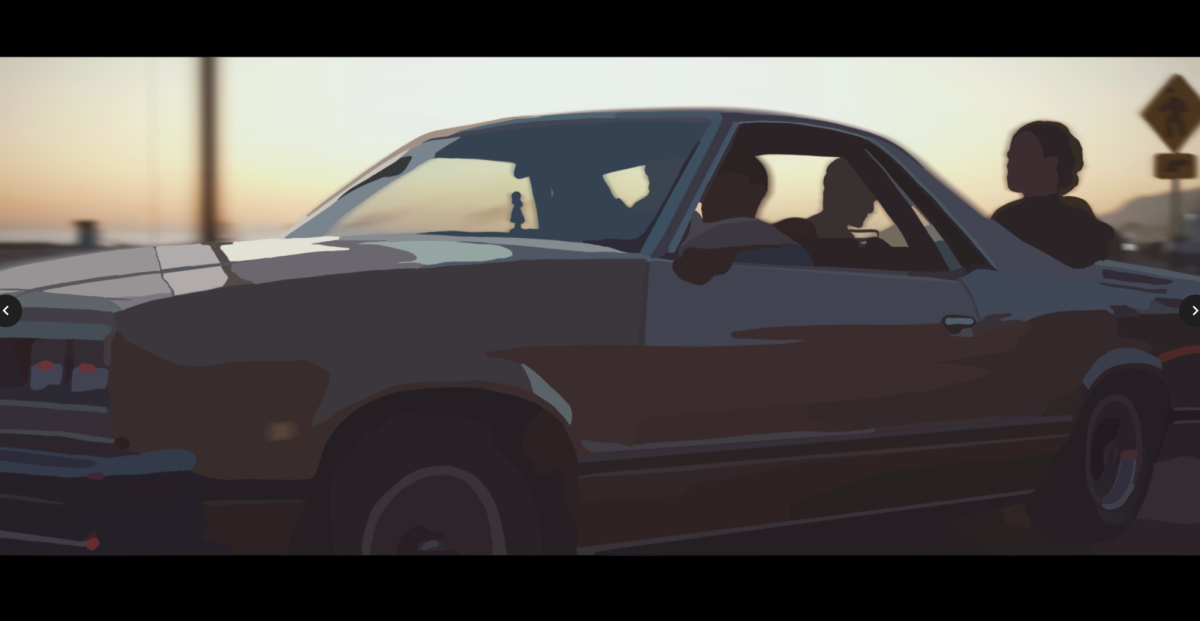
“Nouvelle Vague” mirrors Godard’s freedom of expression with intention: overexposed frames offer an unvarnished look, shaky motion reflects the rough documentary-like filming that defines the New Wave, and the editing relies on abrupt jump cuts to disrupt the illusion of traditional “invisible editing.” By defying the artifice of filmmaking, both Godard and Linklater turn misinterpreted errors into a stylistic choice.
Suspended between fiction and reenactment, Linklater’s dazzling recreation of late-1950s Paris and its anti-establishment sentiments reverberates. Through the black and white landscape and 4:3 aspect ratio, the film transports the audience into the brilliant chaos of Godard, a genuine time capsule of an era. Not only does it succeed with its cinematography and worldbuilding, the behind-the-scenes passion resonates universally. However, the inside jokes and historical references will land best with cinephiles.
Even structurally, it avoids narrative handholding. It plays less like a biographical portrait of Godard and more like a period-pastiche documentary as the audience becomes aware of its lack of conventional linear narrative. As a “hangout” genre, many scenes linger over intimate, philosophical conversations between Godard and his small crew as they lounge and dance in cafés. Linklater invites the audience into Godard’s enigmatic creative process by collapsing the distance between the audience and the screen, making them participants rather than detached spectators. You can’t help but slowly fall in love with the chaos.
Tinged with light-hearted affection, “Nouvelle Vague” feels digestive for both cinephiles and the general audience. Linklater replaces traditional romance by romanticizing the act of filmmaking, youth, camaraderie, courage and the eternal love of cinema.
By removing the density of what could have become an academic documentary, Linklater instead borrows the elements of documentary style to reinforce a sense of authenticity, redirecting them towards a poetic meditation on the ordinary with steady warmth. It stimulates one’s inner muse by stirring an uncontrollable urge to direct their own film, even without a classical narrative structure.
In “Nouvelle Vague”, the actors are walking embodiments of revolution, moving beyond the usual impression of mere historical figures. As Godard, newcomer Guillaume Marbeck – hidden behind the iconic sunglasses – portrays disobedience with playful confidence. His unbothered expression and controlled reaction holds both the authenticity and arrogance of a young first-time director, and that opacity adds a mystical edge to the rebel persona. For a debut performance, Marbeck deserves a standing ovation.
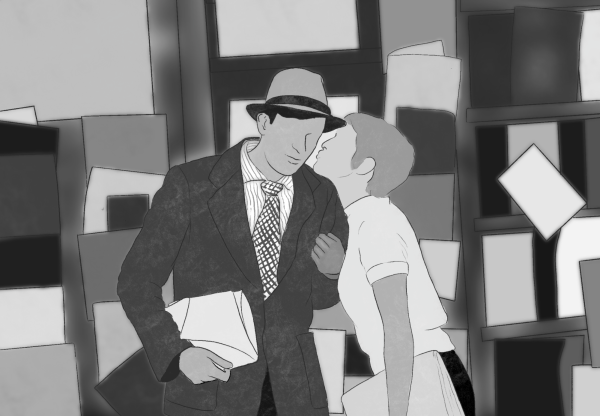
Zoey Deutch plays Jean Seberg with radiant energy, capturing her growing unease as she panics over Godard’s seemingly directionless workflow. Meanwhile, Aubry Dullin taps into the soft charm of Jean-Paul Belmondo, effortlessly portraying an actor uniquely attuned to Godard’s unpredictable yet determined vision.
The chemistry between the two actors deepens as Seberg gradually embraces Godard’s spontaneity. What begins as hesitation turns into active trust. Godard expresses, “what is difficult, and important, is to advance into unknown lands. To be aware of danger, to take risks, to be afraid.”
Linklater’s casting choice feels intentional. The actors’ rather unadorned faces allow for complete immersion without dwelling on their preexisting image. Their physical resemblance to the historical figures adds to the experience, but more importantly, resembles their rebellious temperament. The cast’s anonymity ultimately gives Nouvelle a more humane texture, turning legends into vulnerable, flawed young artists driven not by fame, but by an almost naive and uninhibited love for cinema as a form of art.
The structure dismantles the myth of the singular-genius, stressing the collective effort behind creation. Side characters, such as Raoul Coutard (camera man), Pierre Rissient (assistant director) and Susan Schiffman (close friend of Godard) carry equal relevance as Godard, Seberg, Belmondo and Truffaut: Godard never monopolized attention. The New Wave and the creation of Breathless remain central to the film from the beginning to end with the unkempt excitement of first-time filmmaking. Linklater doesn’t depict an individual but rather, the zeal of filmmaking. The film finds humour in the disastrous, hard-to-argument nature of Godard’s process, which feels profoundly human like so many of Linklater’s great works. Yet it never shakes off the society’s disapproving gaze, as though it anticipates Godard’s surrender to the old fashioned way. With such tension, it never gets boring.The director himself confesses that “Nouvelle Vague” is an “homage to the point in film history we just love.” He pays tribute to Godard and to current filmmaking, as he argues that authenticity lies not in control but in experimenting with uncertainty, adoring the accidents and the messy process. Linklater reminds the audience that artistic creation is rarely born in solitude, but in good company. Perhaps a cheap, shaky camera, a few friends, and a heart of rebellion creates the kind of revolutionary magic that only cinema can.