














































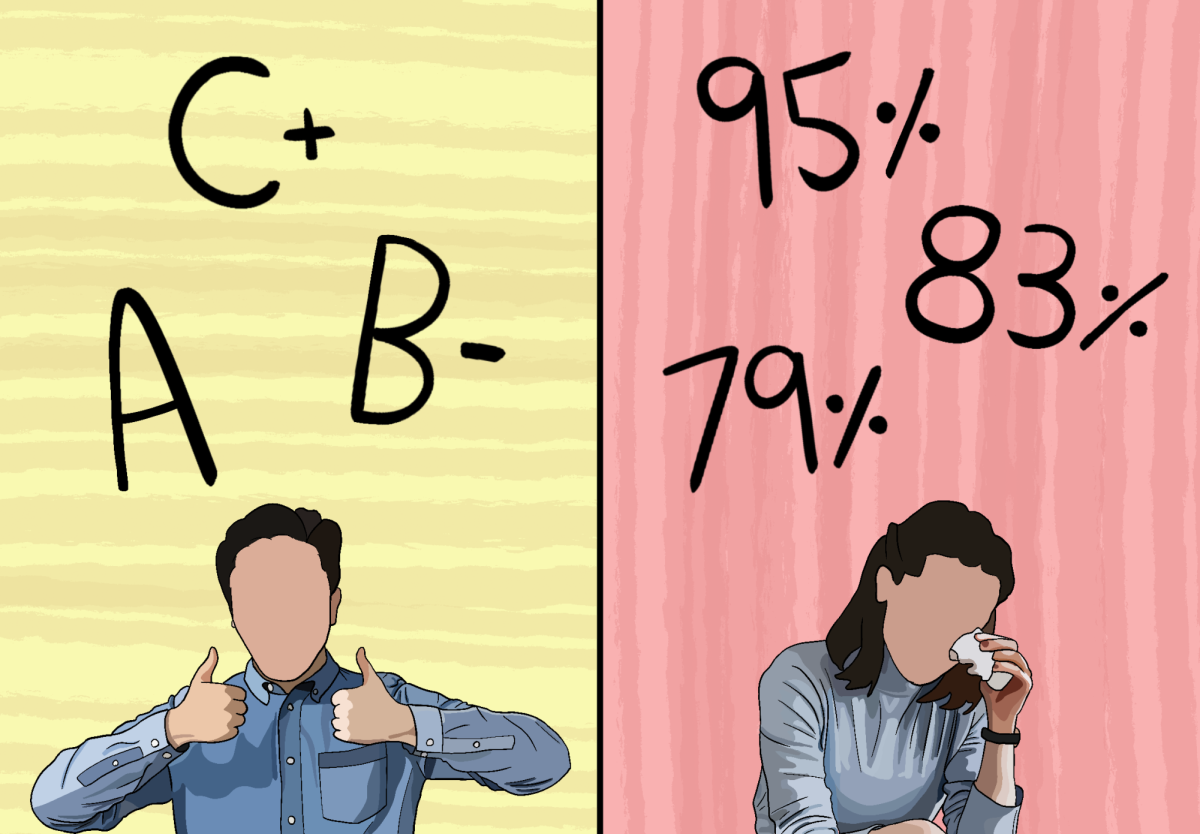
The administration announced a transition from the original 100-point scale to the “alpha mark” scale in the 2024-2025 school year. The policy intends to focus grading on student understanding and progress and fine numerical differences, making assessment more transparent, fair, and learning-centered. One year into its implementation, while some gaps remain in the policy, student opinion remains positive overall.
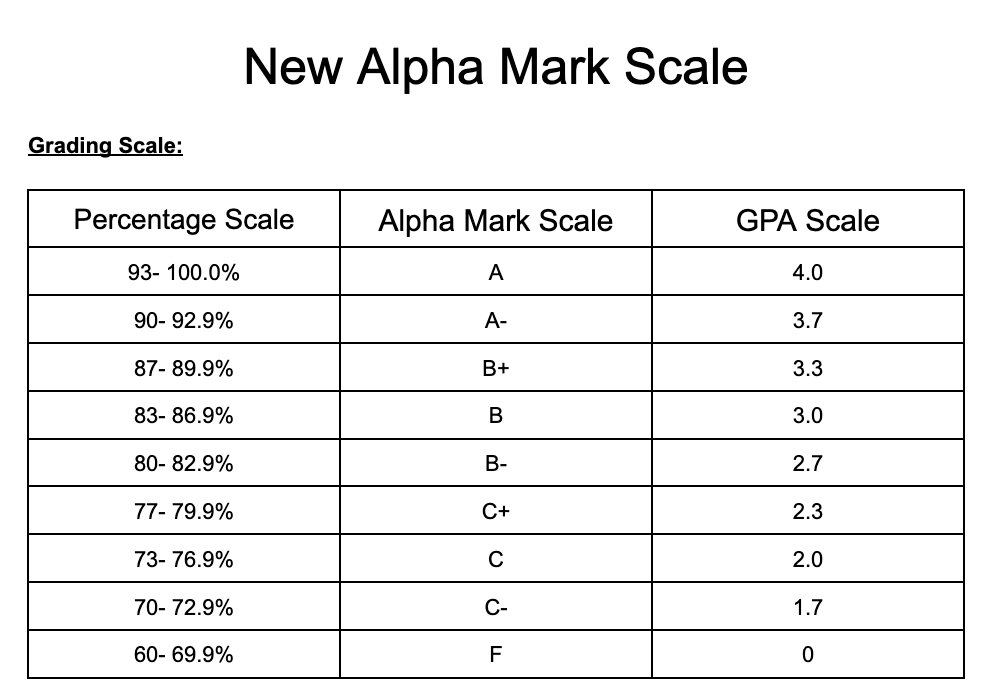
The alpha mark scale presents student grades in PowerSchool and transcripts in letter form. “If you are a current junior [or underclassman], your grades for class will show as a letter grade and below it shows the scale of what constitutes that letter grade,” said academic counselor Mrs. Jolly.
The alpha mark scale aims to more accurately represent academic achievement. “The alpha mark scale is a move towards standards-based grading while still being adaptive to the needs of the school. It requires more thoughtful grading from me as a teacher,” said secondary math teacher Mr. Coleman.
The more immediate implications of the policy emerged in the retake system. The alpha mark scale aimed to put an end to the “retake loop,” where students sat for reassessments after scores that already demonstrated academic proficiency.
“I certainly feel from the students that they look at their test more as earning an A than a 100 which in that sense is respecting the idea of proving mastery versus that they can get a 100 on the test. This as a result has led to the amount of retakes decreasing,” said Mr. Coleman.
Initially, some students feared that the alpha mark scale would exacerbate the school’s already prevalent GPA inflation. In particular, they worried that if more students achieved the maximum score (an “A”), then their academic capabilities would seem equal to those who received lower scores on the 100-point scale.
“The general atmosphere was very positive about the change, since there would be less stress because it is easier to get an A. There are good and bad sides, but some bad sides are that [students] can’t differentiate themselves from other students through grades, while in the past, that might have been possible,” said junior Yujun Piao.
This concern manifests in the selection of the class valedictorian. Now that multiple students receive all “A’s ” with maximum rigor courses, the administration has yet to decide how to choose the valedictorian. While this may seem like a penalty for top-achieving students, most of the worry arises from concerns that they may lose “an edge” in the college admissions process.
However, even in previous years, the administration announced the class valedictorian in February-March, after Regular Decision deadlines for most universities worldwide. Given the time and effort necessary to earn such grades alongside its minimal impact in admissions, the alpha mark scale may act as a more realistic solution that provides students the “edge” they seek.
While scores on the 100-point scale may serve as a better marker to differentiate oneself from peers in an academic setting, the alpha mark scale allows all students to devote their time to factors that sway college admissions more. Especially for U.S. admissions, GPA increasingly serves as not a differentiating factor, but rather a baseline.
According to Harvard University’s Common Data Set, the average weighted GPA of admitted students has skyrocketed from 4.03 in 2014-2015SY to 4.21 in 2024-2025SY. When most admitted students have near-perfect GPAs, the difference between applicants shrinks to decimal points. In the holistic admissions process, other factors such as extracurriculars or personal character demonstrated in recommendation letters play a far larger role in the admissions room each spring.
“Students aren’t really differentiated academically anyways in any case. They already have such similar GPAs all together. I totally understand the concern but at the same time differentiating academically is not our problem in our top universities. What matters more is what you’re doing outside of school, what you are doing as your extracurriculars, and not only doing those extracurriculars but also leaving an impact,” said Mrs. Jolly.
Ideally, with infinite time and resources, one would build compelling projects while grinding through retakes to maintain the perfect GPA. However, especially in sophomore and junior years, students often must decide priorities in devoting time to extracurriculars or a 0.01-point boost in their cumulative GPA.
Under the previous scale, students often chose the latter under the psychological illusion that admission officers would notice the two points they missed in a single course more than they would progress in an extracurricular.
The alpha mark scale relieves students of this burden by allowing them to maintain top-school caliber grades while building other aspects that will differentiate them from the 50,000 other students in the applicant pool. “Since I take less retakes, it allows me to devote more time to my extracurriculars. Looking at my profile holistically, it did benefit. It is for sure that the alpha mark scale has opened up more time for extracurriculars,” said Piao.
At the end of the day, all academic systems, including retakes and the alpha mark scale, impact students. Thus, their input remains the most significant as the administration looks to fine-tune such policies. Mrs. Jolly said, “We can’t make everyone happy. When the 100% weighted GPA was here, you’d be surprised at how many students came in to want a 4.0 scale. It just depends on the student perspective, and there are many other factors, such as teacher recommendation, extracurriculars, that play a role in shaping you as a student.”









Sean Kim • Mar 25, 2026 at 7:33 pm
I really liked the change of the alpha mark scale as this article showed us the initial concerns about the new alpha mark scale.
Volt • Mar 25, 2026 at 7:31 pm
I think this article informs me of how alpha mark scale is giving positive impact. At first when I herd about the new alpha mark scale I honestly didn’t know the reason for it. But as I read this article I found out how this had benefit of spending more time for extracurricular works than retakes.
Mrs. Jolly • Mar 25, 2026 at 6:13 pm
I like this article because it shows why students and teachers generally support the change to the alpha mark scale while addressing initial concerns as well. Well done!