








































A 50-year-old senior limps towards a lift that groans as it climbs slowly eight floors up. With strong winds, creaky floors, and minimal barriers, a slight misstep could end one’s career – or their life.
This perilous scenario mirrors the cold reality behind South Korea’s abundant skyline. Beneath the grand structures lie the sweat and tears of workers who raise the concrete structure by hand. In fact, the construction business often underestimates the level of danger in the services of those in the field; from a plasterer to a rebar worker, their daily tasks carry a high risk of injury and accidents.
Construction work in Korea carries dangers that are often overlooked or underestimated. While the construction of sites symbolizes progress, they also reveal a pattern of preventable injuries and deaths. Korea Institute of Construction Industry reports that Korea holds the highest construction accident death rate among the top 10 OECD economies, with 1.59 % of deaths from work-site incidents.
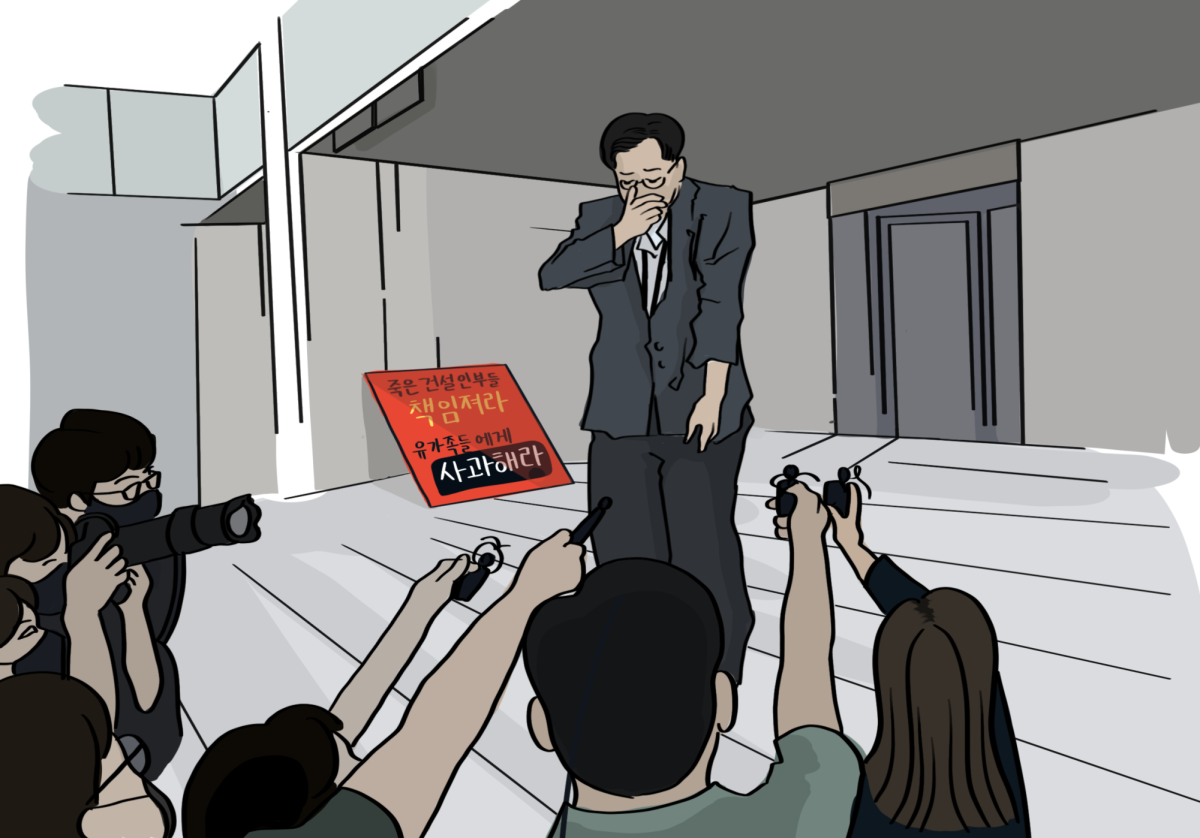
A recent accident illustrates this severity. In April, a 60-year-old worker fell to his death at a Posco E&C site in Daegu, unprotected by any safety gear. This was one of several fatalities reported across the company’s projects in a matter of months, which prompted temporary shutdowns at multiple sites. This includes the Posco Anad Beomeo project in Daegu. Other companies, such as HS Huansung, also underwent safety inspections in different venues.
But within days, construction at the sites resumed, well before any official check confirmed the site was safe. The moment demonstrates a harsh paradox: stopping work protects workers in the long run, yet long delays threaten their income. “When construction was halted, our livelihoods were in jeopardy, but now that construction has resumed, we’re relieved,” said Jung Kyung-ho, a plasterer at the Anad Beomeo site.
With the occurrence of recent incidents, President Lee declared a nationwide “war against industrial accidents,” and laid out a statement aimed for a lower fatality rate to the OECD average level of 0.29 deaths per 10,000 workers by 2030.

Despite the bold rhetoric, the policies behind it prove insufficient. Heavy fines and punitive regulations often push companies to cut costs elsewhere, which inadvertently overlooks workplace well-being rather than enhances it.
Reforms also remain slow and inconsistent. The government’s “5th basic plan for the improvement of employment in construction workers” promised better welfare and stronger protections, but repeated delays cast doubt on its effectiveness. Without clear timelines and enforcement mechanisms, the danger persists.
As government-led reforms falter, collaboration between industrial sectors grows increasingly necessary. “An active industry-level measure is needed along with national strategies which raise overall workplace safety to a global standard,” said researcher Na Gyeong-yeon from Construction and Economy Research Institute of Korea (CERIK). While state provisions set the backbone of the construction welfare, a more interactive environment from the employer and employee can eradicate immediate concerns.
Jointly-established limits on daily workloads and consistent job-site hazard assessments could offer the direct protections that top-down reforms struggle to implement. The imminent adoption of the “Yellow Envelope Act,” which promises expanded union clout bargaining power, may help push negotiations between labor and management in a more constructive direction.
Despite Korea’s construction surge, the welfare of its builders remains in jeopardy. As profit-driven companies prioritize speed over safety, the nation must devise a method that balances commercial demands with enforceable on-site protections. Until worker safety becomes more than a political campaign, sustained scrutiny and collective action remain essential.





NicoleVickio#3482 • Mar 26, 2026 at 5:53 am
Sooo much pressure, right? I know I wouldn’t want to be a mayor any time sooon.