












































Amidst the global push for AI in education, South Korea positioned itself as the world’s first implementer of AI into the official national education curriculum. Classrooms flipped over paper pages and transitioned to screens as the government drove forward the 2023 “Digital Education Transformation” legislation. The overarching goal was clear: to mitigate education disparities and teacher workload.
However, the top-down rollout of AIDT prioritized political and corporate commitments over the voices of teachers and students, undermining education quality and legitimacy. The policy push advanced under insufficient consensus among teachers, local officials, and parents; each party splintered onto parallel tracks with no common measure of success in student learning and equitable classroom practice.
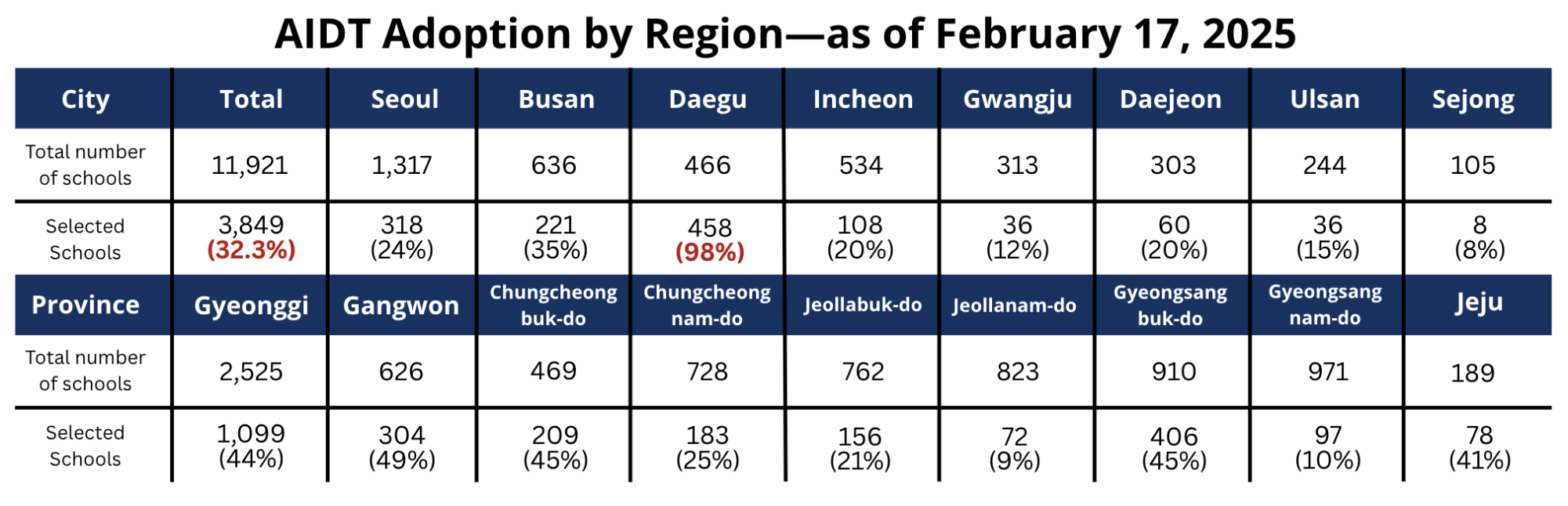
With an adoption rate nearly triple that of other regions, Daegu stood out as a rare case of unanimous institutional alignment behind the rollout. In contrast to government data, though, 77.4% of teachers in Daegu claimed not to use AIDT in classes, and 94.8% expressed that digital textbooks barely mitigate education disparities.
This statistical paradox hints at the inconsistent directives and decision-making processes that exclude faculty voices. “Our inputs were barely ever reflected,” said Kyongwook Lee, a 20-year secondary educator in Daegu. “In fact, I understand that in many cases adoption was decided solely by the principal without conversation with the teachers.”
This caused doubts about the feasibility of integrating AIDTs into classrooms. “Most teachers worry that applying unfamiliar digital textbooks in classrooms will, contrary to claim, result in excessive workloads and learning gaps for students…I’ve also heard that pilot schools are experiencing many difficulties running the program.”
Citizens also criticized the hasty implementation of AIDTs without proper steps to cultivate digital literacy. Choong-gwon Lee, a big data professor at Keimyung University, said, “For students who are not proficient in using digital devices, the academic gap will only widen further.”
Despite the public backlash and repeated delays caused by unresolved logistical complications, the Ministry of Education pushed forward with pre-subscription contracts to edtech companies, simply repeating—without substantive evidence—that the novel AIDT will mitigate education disparities.
Following the loss of political momentum after the December 3rd Martial Law, the opposition resistance pushed the initiative to the brink of collapse. In response, the Ministry of Education prompted a parliamentary reversal and redirected the mandate to voluntary adoption while legal and regulatory frictions continued to compound. Subsequently, South Korea’s National Assembly stripped AI Digital Textbooks of their official status and reclassified them as supplementary material.
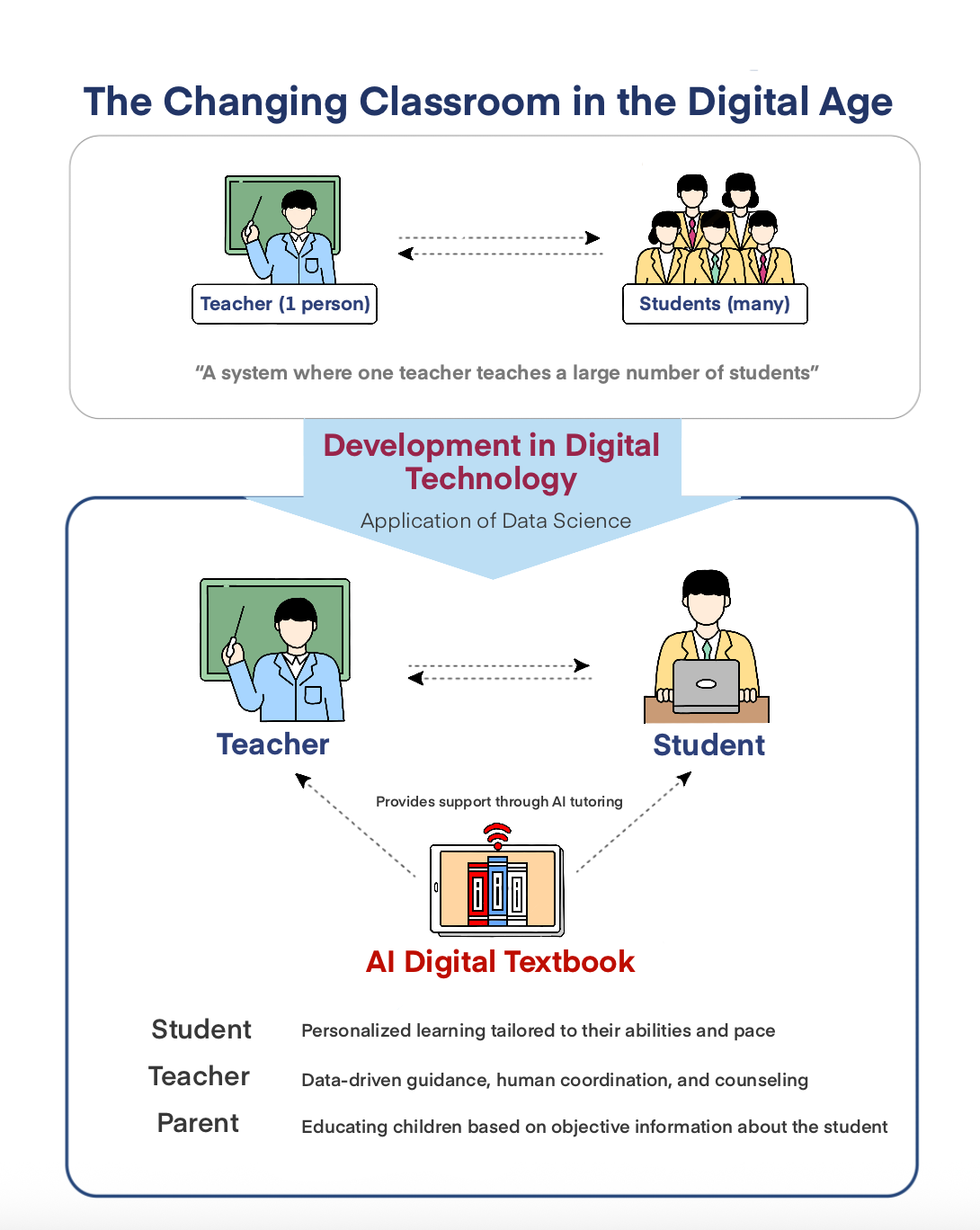
As AI literacy becomes the new cognitive currency, the eventual implementation of AI in education stands as necessary and inevitable. The problem was never the technology itself, but its haste in adoption.
Donghyeon Kim from Daegu’s Ministry of Education acknowledged that the Ministry’s inconsistent directives only fueled uncertainty. “All provincial and metropolitan offices of education had understood from last year’s regulations that AIDT would be introduced nationally. Despite it being a stated law, the Ministry later made it optional. This caused a great deal of confusion at the provincial level…it all felt too rushed,” said Kim.
The government, caught up in the grand cause of a “digital transformation,” rushed to introduce AIDT, which resulted in a situation fraught with contradictions. With the nationwide mandate reversed, edutech companies found themselves with unused subscription fees and ambiguous directions. Meanwhile, schools remained bound to billion-won contracts based entirely on the assumption of guaranteed success. This misalignment served neither the needs of educators nor the system that fueled it.
On the other hand, Kim views the downgrade not as a setback but as a necessary pause for reflection and review. “Personally, I think the downgrade to ‘supplementary material’ created an opportunity to finally go through proper verifications…in fact, this year [Daegu’s Ministry of Education] has been conducting policy research to review the parts that were implemented hastily last year.”
AIDT’s legitimacy within education will only hold if the voices of teachers, students, and classrooms themselves are meaningfully heard with sufficient time granted for real validation, correction, and growth, not just to push legislative agendas.







GG • Nov 13, 2025 at 6:38 pm
Thank you for this great article! In my opinion, I think that AI is not developed enough to be used in the field of education. I heard that AI is not “making” the answers to the questions given, but just predicting the answers that the user would want. I think that the usage of AI in the schools needs to be reconsidered because of its inaccuracy and under-development! Especially as a student, i think that there is so much potential for AI if it’s developed further more.