















































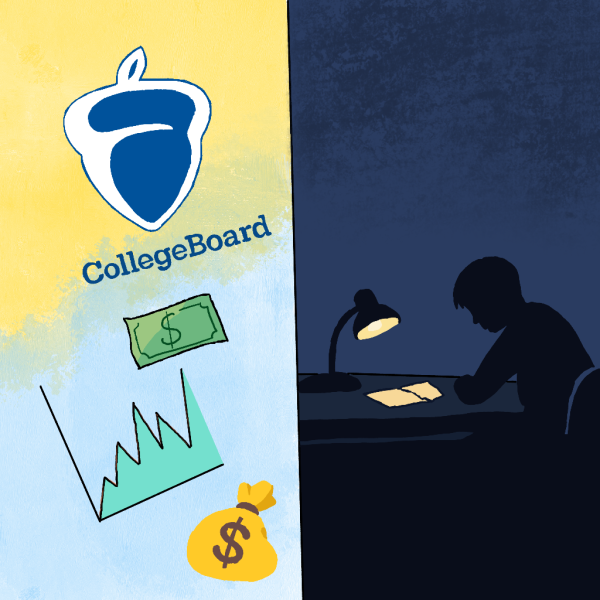
Two million students take the SAT every year. With $68 per exam, the College Board generates $136 million in revenue from the exam alone. On top of that, AP exams and extra fees incurred by international students allow the organization to rack up over a billion dollars in revenue each year. Despite its status as a “non-profit,” the College Board’s massive financial returns raised eyebrows among students and teachers regarding its financial practices.
The College Board administers and oversees various standardized tests and educational programs. With their most famous AP (Advanced Placement) programs and the SAT, the platform shapes academic pathways for students who aim for an American university.
When a single organization shapes both testing and course framework for undergraduate admissions, students have few alternative paths to prove their academic aptitude. The College Board’s monopoly allows it to increase exam costs continuously by $1-$2 each year, and students have no choice but to succumb.
The immense revenue aggregation contradicts the “not-for-profit” nature of the College Board. Although these organizations aren’t supposed to monetize from services, College Board has been generating profit for the past 15 years: in 2023, it held over $1.77 billion, keeping $4-14 of every $100 it takes in.

Even though investments to broaden access – such as a $37 fee reduction for lower-income families and the National Merit Scholarship – take up a big part of its revenue, the top executives of College Board still get paid over $350,000 a year, double the salary of a typical “not-for-profit” manager.
The irony lies in the limited financial support available to lower-income students despite the organization’s plentiful financial reserves. Many still struggle to even afford the exam with increasing costs, juxtaposed with all the profit the College Board generates.
Outside of financial mishaps, the organization also faced criticisms for persistent technological issues on its platforms. Despite their seemingly robust monetary capabilities, the company repeatedly proved itself unable to proctor tests, like in the disastrous March 2025 SAT exam, where millions of test takers faced technical difficulties. “This SAT was really laggy and uncooperative, and a lot of my friends were frustrated,” said discord user mistycandy.11. “[It] is really concerning, because we give the College Board so much money, but they can’t seem to proctor a simple test.”
Even aside from test-day conditions, the inadequacy of the College Board frustrates daily through its buggy, elusive website and procedures. “There’s been multiple problems that we’ve had to contact the College Board. Sometimes it’s like someone’s portfolio password doesn’t work, so you have to call and fix that,” Mrs. Jolly said.
In sum, given the millions of cases of unprepared students and technological failures, the organization’s monetary prioritization and monopoly directly contradict its stated mission: “to expand access and remove barriers for all learners.”
Therefore, the College Board must initiate massive reforms to satisfy its designation as a non-profit. Organizations like the International Baccalaureate can serve as models, with the administrative body composed of the Board of Governors that oversees policies and financial management.
Equally important is the institution’s redirection of its resources towards enhanced student experience, including both equitable support and a stronger digital infrastructure. A broadened scope of aid for lower-income students could ensure a fairer opportunity to compete in college admissions. In addition, investments for efficient digital operations remain crucial.
Governments can also act to counter the organization’s sole dominance by funding an alternate college admissions system that provides standardized testing services and learning materials similar to what the College Board provides. Through a reformation of the College Board itself and intervention from the government, the student college admissions process can become truly equal and fair.
While the College Board claims to “democratize the college admissions process,” it falls victim to monetary incentives. Without extensive reforms in its financial models, the institution will continue to aggravate academic inequalities and ignite criticisms for its commercialization without meaningful incentives.