



































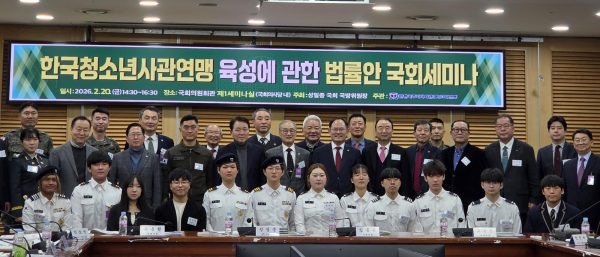
DIS Junior Reserve Officers’ Training Corps (JROTC) members attended the Seminar on the Korean Youth Cadet Development Act in the National Assembly of South Korea on Feb. 20th. They conversed with lawmakers on the status of JROTC organizations in the nation and disseminated a unique student perspective.
Members of the National Assembly first proposed the law six years ago, where it then underwent heavy deliberations. “Being a bill, it required years upon years of discussions with opposition lawmakers,” said National Assembly member Jong-Ill Song. “This seminar is the culmination of all that effort, and the first step to passing it as a law.”
It aimed to develop a more centralized JROTC program and provide extra governmental support towards schools with established JROTCs. “JROTC programs are expanding…there’s 33 now [in South Korea]. But the government doesn’t give them enough support, which can cause issues in funding and activity,” said junior Aiden Huh, JROTC student conductor at DIS. “The lawmakers invited all the JROTCs [in Korea] so that they could get student voices into the discussion, and I decided that it would be a great opportunity for our cadets.”
Ministers in favor also expressed their interest in expanding the South Korean JROTC program to increase interest in military programs, which have recently faced decline. “After World War II, many countries demilitarized, removing programs that encouraged military-style student participation,” Song said. “Due to the threat shown by North Korea, our country must not follow the same path.”
Huh had a unique opportunity to conduct a speech in front of lawmakers and military personnel involved with JROTC, expressing his concern with the lack of centralization and funding given to JROTC programs in South Korea.

“I wanted to express my concern with the lack of support that the government has given us,” Huh said. “Many others, including the Joseon University JROTC cadets, expressed their own concerns to the lawmakers.”
Among lawmakers, student voices introduced distinctive ideas often absent from governmental discussions. “I mostly talked about the student perspective, which was something that the lawmakers lacked in their discussion,” Huh said. “Korean JROTC programs suffer because of the lack of governmental support, which leads to less activity and a generally lower quality of JROTC education.”
Other members who attended found the session insightful and valuable. “I think this was a good experience…I found it interesting that we could talk with lawmakers,” said junior cadet Mihini Edirisinghe. “Even though I’m not that good at Korean, I still understood a lot.”
The uncommon experience left DIS cadets looking forward to future opportunities to continue on with their dialogue.“The seminar is only the beginning,” said Aiden Huh. “Our JROTC will be invited once again to the National Assembly in the future, so I want cadets to look forward to that.”