














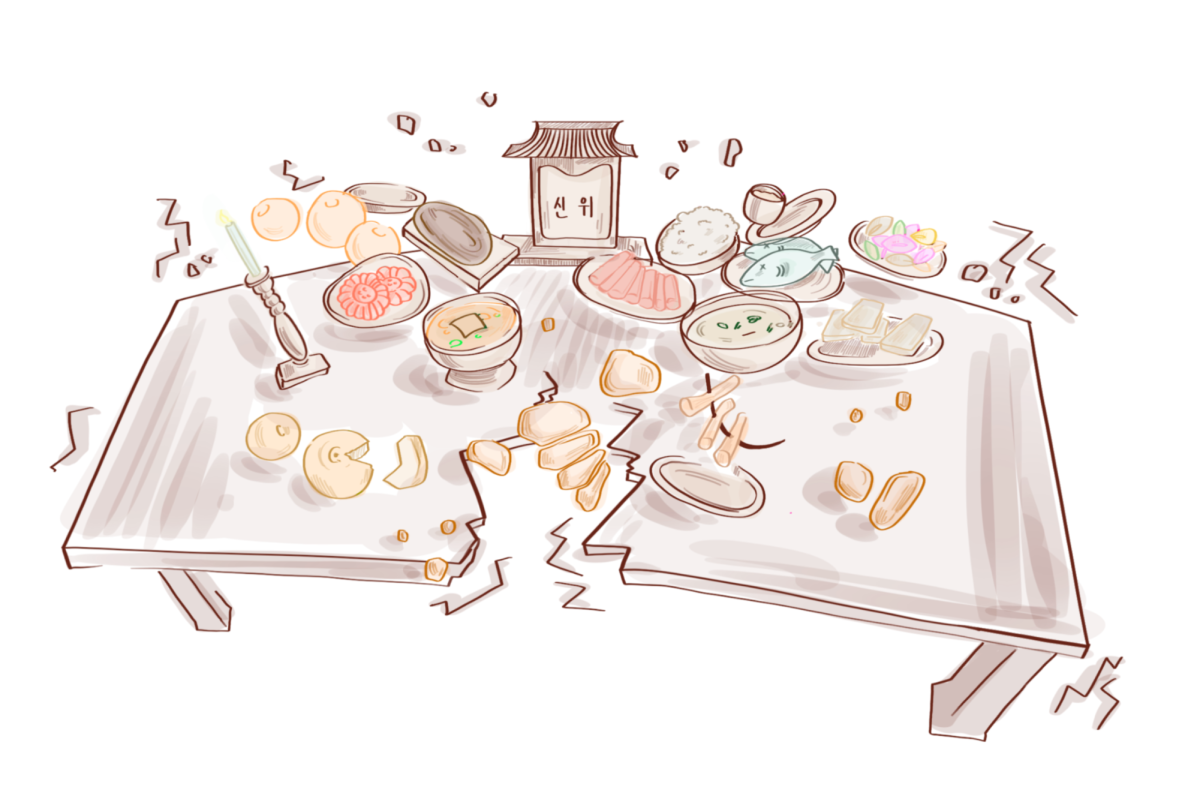














Many of America’s young watchdogs, infuriated, reported on recent administrative threats to student press freedom and the First Amendment. As student journalists, they monitor the authorities, question official decisions, and hold institutions accountable on behalf of their communities. Korea, on the other hand, remains relatively tranquil—mayhap, systemically silenced. In the absence of an institutionalized journalism curriculum, where the Ministry of Education purportedly integrates such ideals into science curricula, Korean students lack the tools to critically engage with official narratives.
Amid this absence and a classroom culture that teaches compliance over scrutiny, Korea forfeits one of the few opportunities to counter the generational crisis of media distrust shaped by decades of political pressure and economic compromise. This failure exposes a democratic contradiction. Youth grow up untrained to scrutinize authority or practice civic responsibility through a free student press.
The legacy of censorship
This history of oppression and indoctrination dates back to the 1950s, when former president Rhee Syngman’s military regime outlawed newspapers and imprisoned opposition-aligned journalists. In the ’60s, former president Park Chung-hee heavily censored coverage of police brutality. The historical control that undermined media credibility continues to influence today’s newsrooms.
Although democratic reforms brought legal protections, manipulation simply changed form from outright censorship to behind-the-scenes influence. Over time, pressures of funds, ownership, and partisan coercion calcified into an economic reality where ethical journalism no longer fed families and, therefore, became unsustainable.
According to the Newspaper Industry Survey conducted by the Korea Press Foundation, 60% of the industry’s revenue came from advertising, while only 16.8% came from subscriptions. Major outlets’ dependency on large corporate advertisers created a system that heightens the stakes of critical reporting. When advertisers contribute more than three times as much as general readers, coverage risks reflecting who pays rather than who needs to know.
A generation of uneducated cynics
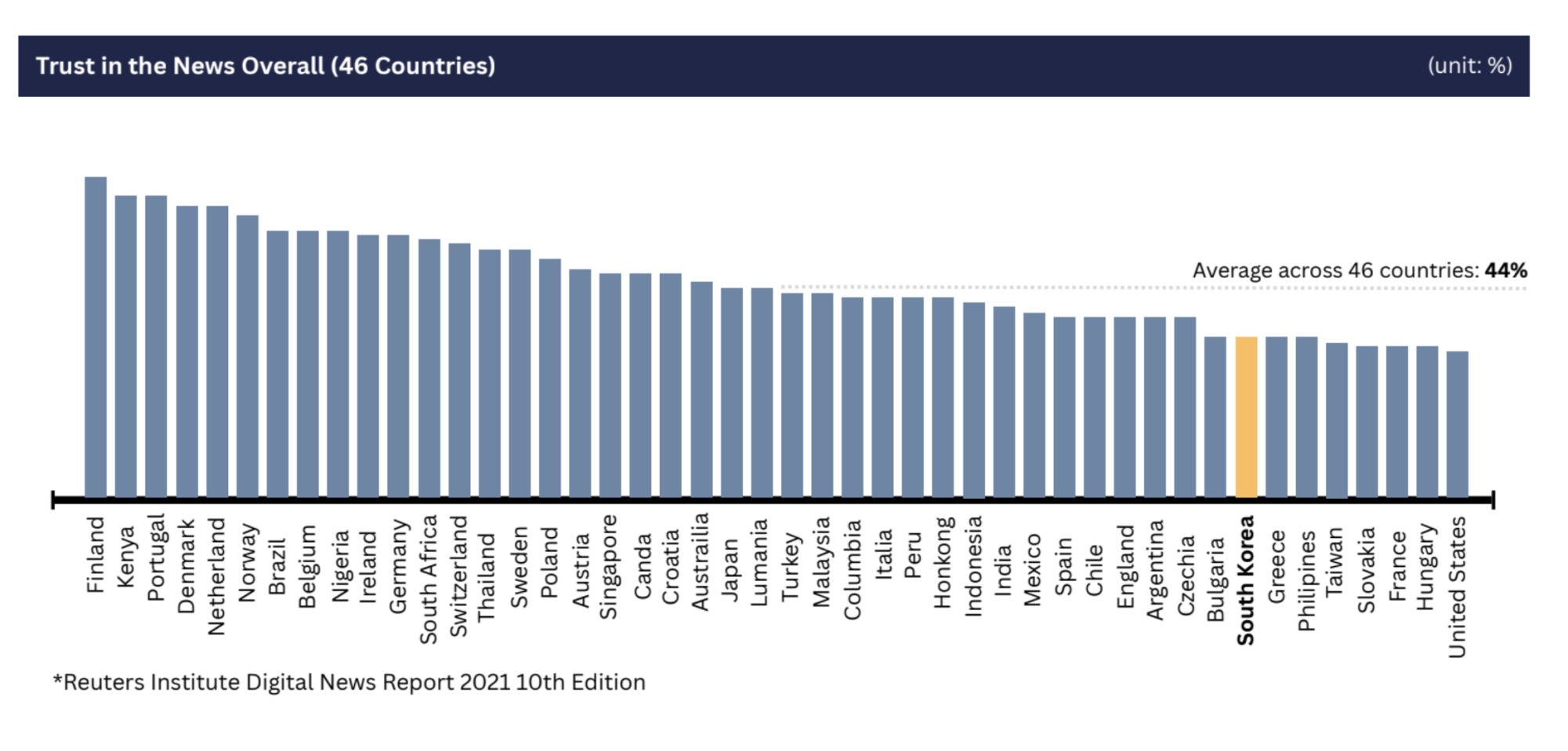
Distrust brews amidst this corruption, and education and media carry it to the next generation. In the absence of structured curricula that rarely teach journalism as a truth-seeking civic practice, Korea’s teenagers dub reporters as “giraegi.” This portmanteau of journalists and garbage dismisses the Fourth Estate as manipulative and unworthy of trust.
This media distrust manifests in online echo chambers. A netizen criticized how the press tailors coverage to political interests. “These so-called reporters in this country have turned into dogs who just bark when their owners tell them to and shut up when told…They’ve become garbage. There are only a few real journalists left in this country. And the time is coming when we should completely ignore and reject the media.”
Accordingly, newspaper readership plunged from 1.2% to a record-low 30% in 2025. By platform, YouTube exhibited the highest news viewership at 92.2%. Trust in public news rose 3.5% points since 2025, yet trust in the press negatively correlated with age.
The Korea Press Foundation highlights the necessity for improved verification systems as video-based news usage grows to address clickbait and biased articles. Yet, conversations about building a generation that critically examines information rarely enter the legislative dialogue.
The critical thinking gap
Amidst the lack of journalism education and deep mistrust toward the industry, students turn elsewhere to make sense of the world. Today, 51% of students rely on algorithm-driven platforms as primary sources of information.
Yet, these sources prey on naïvety—they chase the clicks, not authentic information. Joonyong Park, a senior at Daegu High School, said, “Relying only on YouTube or social media [for information] is like living in a house with windows on just one wall. If you have windows facing all directions, and even a skylight, you can see the outside world more clearly. Newspapers and broadcasters function as those multiple windows…For students, journalism education means gaining many windows through which to see the world.”
When youth depend on spaces designed to reward engagement over accuracy, their ability to critically assess information weakens. “Journalists can raise questions, and point out suspicions…But in reality, even when something remains only an allegation, many people treat it as a fact.” Joonyong Park, a student at Daegu High School, said. “When someone says, ‘I heard this happen,’ people often just accept it without questioning. When the majority of students rely on online communities that profit from telling audiences exactly what they want to hear….it’s even more important for students to learn to absorb political perspectives more critically,”
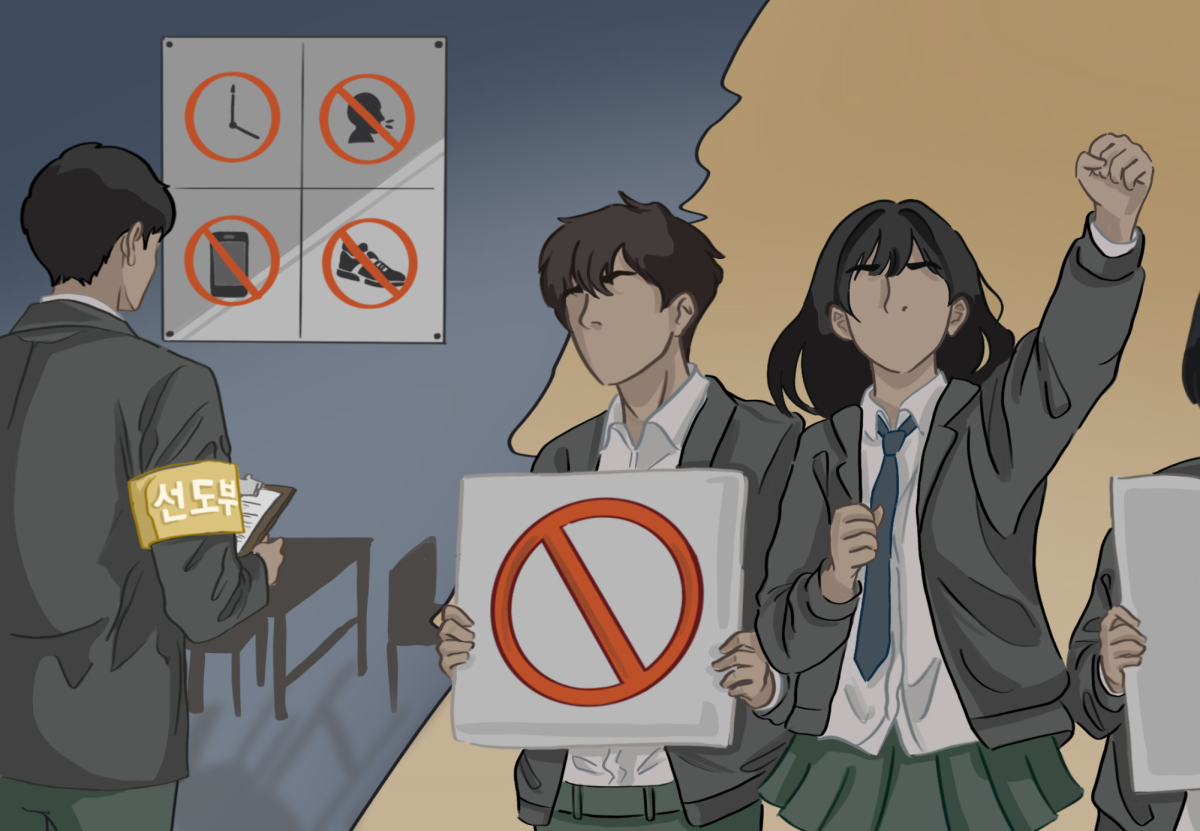
Despite this, Korea’s education system doesn’t stop at excluding journalism from official curricula; schools, the very spaces meant for inquiry, students face oppression for raising questions. Park revealed, “In subjects like history or social studies, individual perspectives can differ. But when a student holds a viewpoint different from the teacher’s, that student often gets reprimanded. That discourages open discussion…In that social ambiance, it’s hard to imagine students voluntarily joining journalism efforts to raise questions.”
This reality differs sharply from education systems that formally protect student journalism. In the United States, laws such as the “New Voice” Act safeguard editorial independence in 96% of high schools. Lilian Richter, Editor in Chief of high school publication FHCTODAY, highlighted how institutional support translates into a durable newsroom culture. “Within our school, we have a very solid newspaper program that has been there since our school was founded…It’s really convenient because we have all of this exterior support.”
Unlike in the U.S., where institutionalized student journalism serves as civic training, Korean secondary schools offer no comparable systemic support, both inside and outside the classroom. A report from Media Education Analysis of Korean curricula observed high awareness of the importance of media literacy, but a severe shortage in content, educators, and programs.
Curricular pressure further sidelines civic examination.
Even in student papers, reporters remain in the confines of on-campus news rather than investigative journalism.
Raising the next watchdogs
While some schools run extracurricular journalism programs, the inactive extracurricular scene (동아리) and the absence of legal protections or national standards limit investigative practices. Sangwook Kim, the Editor in Chief of Daegu High School Newspaper Club, said, “As students, we have to focus on keeping up our grades and prepping for the CSAT…because of these demands of the curriculum, we rarely have opportunities ot investigate broader social issues, let alone investigate issues even within our own school.”
Because youth remain among the few voices unrestricted by economic pressures that undermine the Korean press, student journalism must play a larger role in curricula. Richter echoes this sentiment, “Student journalists have the upper hand there because most of them are self-sufficient…[here in the States, program funds] aren’t from schools and we can say, ‘you guys don’t have the right to censor us because you do not fund us.’”
Participation in student press reshapes how students engage with information and reinforces democracy’s habit of self-scrutiny. “When you question everything, you’re able to understand the why of the matter and why it’s important, or why you might not agree with it…It really ensures that you’re thinking through issues and being your own person… you’re not just going with the answer somebody’s saying,” said Richter.
Systems and educators must nurture an environment that values curiosity, civic interest, and a desire to understand the communities around them. Early exposure to press ethics and responsible journalism creates a foundation of trust that national media alone cannot build. If Korea anchors this approach, student journalism could rebuild the Fourth Estate from the ground up.
Credibility cannot be restored simply through new regulations or newsroom reforms. It requires civic habits that allow every member of a democracy to scrutinize itself. This begins with youth who view the press not as a civic responsibility, not as a threat. Korea must raise a generation that understands the value of truth and actively participates in the information system they will inherit; this change begins in classrooms.



Bryan • Feb 12, 2026 at 6:30 pm
Great article! So insightful