






























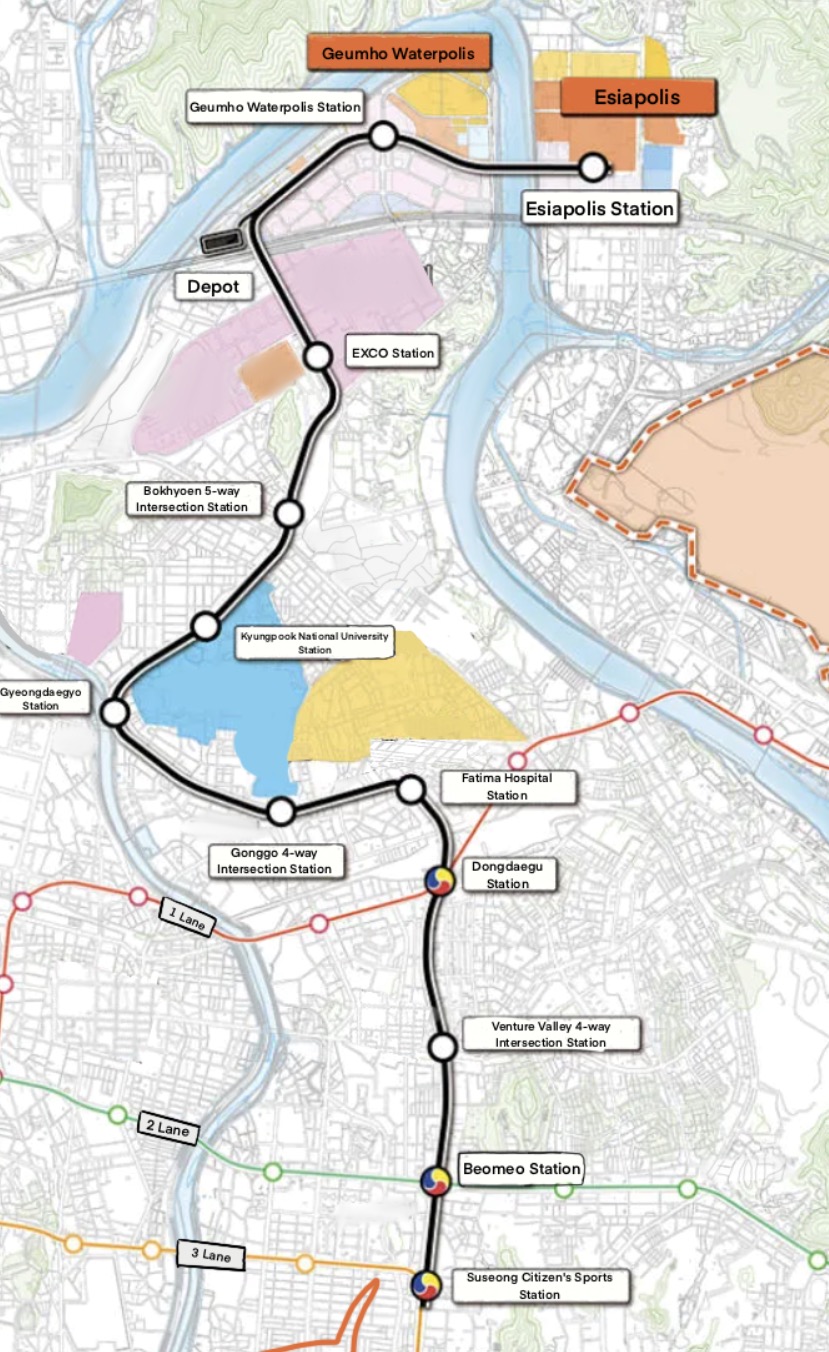
The Daegu government aims to connect transportation-deprived areas of the city with a new rail line along a 12.56 km stretch of tracks. Passing Kyungpook National University, EXCO, and a final stop in Esiapolis, the Daegu Construction and Transportation Committee anticipates the line 4 project to be completed by 2030. A total of nine new and three existing transfer stations make up line 4. But the project introduced contentious deliberation between private business, public officials, and local residents and an unexpected budget increase
Original courses 1, 2, and 3 left the outskirts of Daegu with a gap in service in the railway system. “The construction of line 4, which will run through the northeastern region of Daegu, where existing subway lines do not reach, is expected to eliminate blind spots in transportation and alleviate traffic congestion on major arterial roads,” said Hye-jin Kim, construction manager at the Daegu Transportation Corporation.
Line 4 provides an enhanced transfer system across existing lines to broaden the range of transport. “Line 4 meets line 2 at Dongdaegu Station, line 1 at Beomeo Station, and line 3 at Suseong Citizens’ Stadium Station. The lines were designed to intersect and facilitate transfers,” said Dong-uk Lee, a member of the Construction and Transportation Committee in Daegu City Council.
The connection between the eastern regions of the city can respond to the needs of the population and encourage the development of local businesses. “It directly connects key economic and educational hubs in the northeast, such as EXCO and Kyungpook National University, which will revitalize the economy of these hubs and encourage population inflow to the outskirts of the city,” said Kim.
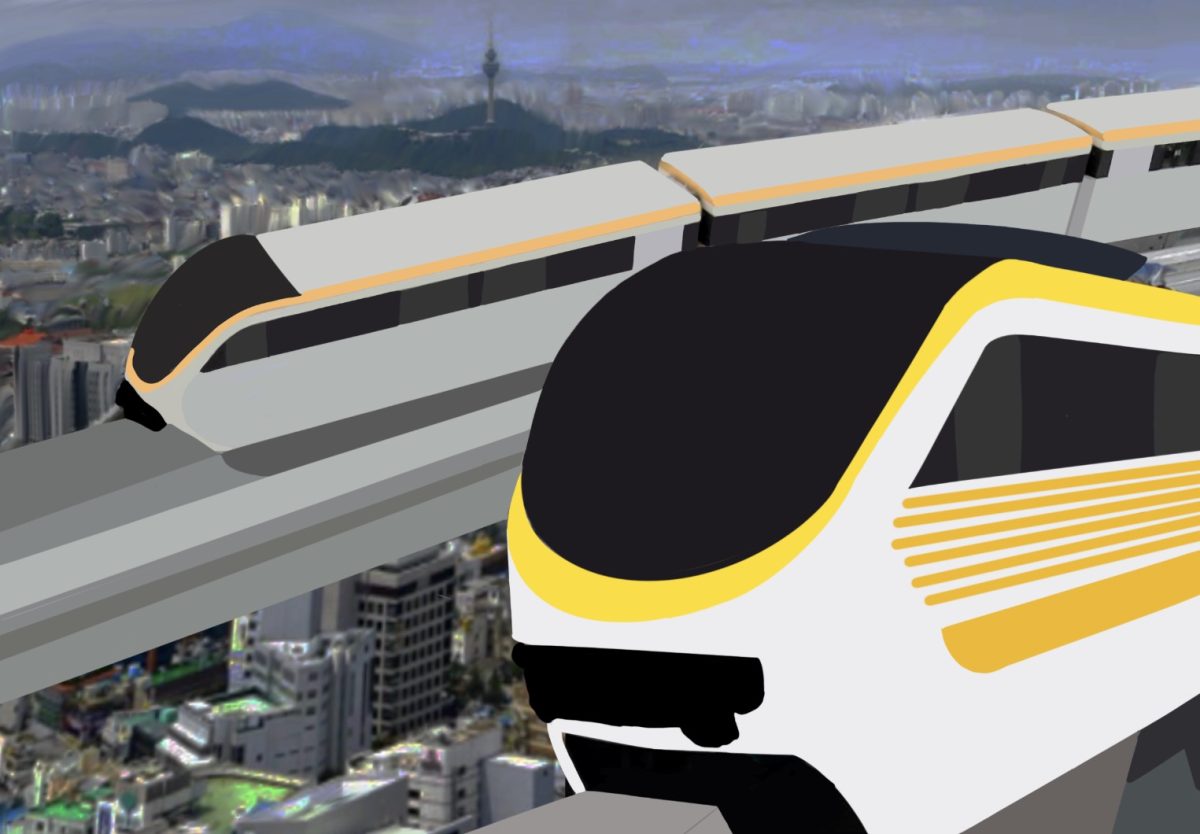
The majority of city council members agreed to build line 4, yet controversy arose over the operational method, torn between AGT [Automated Guideway Transfer] and Monorail. Made with simple, thin, single rails along with rubber wheels, the sleek design of the Monorail results in minimal impact on cityscape views for residents near the tracks. They also keep noise and vibrations relatively low. On the other hand, AGTs require pillars ten meters high and a top plate eight meters wide, which disturbs views of the city skyline, and steel wheels produce high noise and vibration.
The Ministry of Land, Infrastructure, and Transport’s legislative update made verification and approval inspections harsher and more stringent than those of previous railway engineering projects. Hitachi, the company in charge of the construction of the line 3 Monorail, requested an exception to the inspection rules under the Railway Safety Act for the installation of Monorails on line 4. They are concerned that their private technology and blueprints may be spread due to exposure during the safety audits.
The Daegu city government and the Ministry of Land, Infrastructure, and Transport opposed special provisions, which led to the use of AGTs. “Hitachi is asking for an exemption from that process and wants to proceed the same way it was done with line 3. Because the regulations have been strengthened, that’s no longer possible. As a result, the Monorail system has not been adopted at this time. Even though the AGT methods will be implemented, residents still prefer Monorail over AGT, so this issue is not yet resolved,” said Lee.
Citizens still prefer the Monorail because of volume and structure. Min-gwan Kang, resident of Esiapolis, said, “I think so too, and I think everyone else thinks the Monorail is better because it’s quieter, thinner, and has a simpler structure. If possible, I still prefer the Monorail.”
Another point of contention arose about the Bokhyeon four-way intersection. Problems arise due to the existence of the overpass in Bokhyeon, which makes the line too high. Underground construction significantly increases the budget. “When using an elevated structure, there are concerns regarding the cityscape, whereas when it is built underground, budget issues arise. Since we were unable to resolve this controversial issue on our own, a study has been commissioned,” said Lee.
Resident reactions remain positive, supportive of better options around Daegu. Seong-Lim Ahn, resident of Esiapolis, said, “My husband’s workplace is near Kyungpook National University. He drives or takes the bus every morning. Since we only have one car, if my husband drives to work, I have to take a taxi or bus to go to my daughter’s house. So, if a railway is built, my husband can take it, and I can go to my daughter’s house more easily by driving.”
More than a single track, the new line holds potential to connect Daegu’s key areas. Lee said, “There are major lines 1, 2, and 3 in Daegu City. After line 4, the construction of line 5 is planned. It may take a longer time or get delayed, but I think it is progressing.” The ultimate goal of this project is to provide convenient and safe transport for all citizens, without any untouched regions.


Yujun Piao • Feb 12, 2026 at 6:25 pm
I’ve been looking forward to this line ever since I joined DIS in 5th grade — now it looks like its gonna be built after i graduate 🙁
i • Feb 10, 2026 at 8:23 am
this seems really useful good article
. • Feb 10, 2026 at 2:40 am
a line that goes from esia to 수성구 could be super useful
Sola • Feb 12, 2026 at 9:45 am
YES PLEASE