









The United Arab Emirates (UAE) government declared an airspace closure due to the missile attacks from Iran on Feb. 28. At the same moment, mid-air, I contemplated my next in-flight meal on the way to Dubai.
En route to Qatar, my mother and I were bound for Dubai with a layover before continuing to Qatar, where I had a college admissions interview scheduled. I boarded the moment boarding began, my heart beating fast from excitement.
About halfway into the flight, the pilot came on to say we might have to return to Incheon. Half-asleep, I tried to piece together what I knew about the Iran-UAE situation. I couldn’t think of any prior attack on UAE soil. I wasn’t sure if that made things better or worse.
Before I could reason my way to an answer, he came back on. We were returning to Incheon. I had no idea where we were in the sky. I thought, with some clarity, that a missile could hit us.
Confused, my mother agreed to buy the in-flight Wi-Fi. When it finally connected, we had multiple KakaoTalk messages from my uncle in Dubai – he’d been watching the news and walked us through what had happened: Iran had launched a missile attack, the UAE had declared an airspace closure, and flights were being rerouted. It relieved me to know what was going on. The flight still provided meals, so I ate dinner, then went back to sleep.
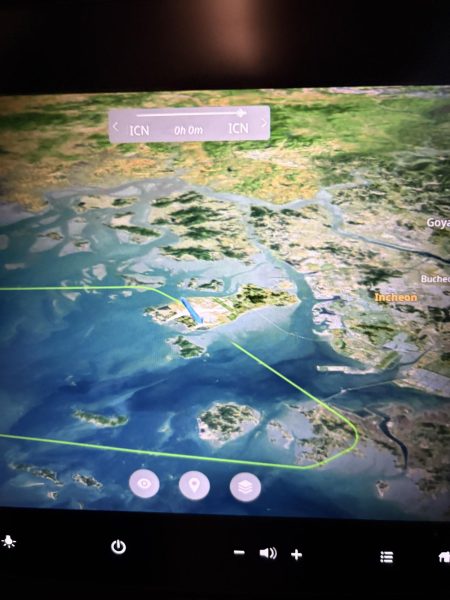
We touched down roughly five hours later. Coming off the jet bridge I saw about 30 workers sort through all the passengers based on their origin. A worker peeled off with about ten of us headed back to Daegu. It briefly made me think of field trips that I went on as an elementary schooler, but the surroundings reminded me once again of the seriousness of the situation.
The staff asked each traveler whether they had bought any duty-free items or not—they informed the customers that since the plane did not leave the country, they had to return them. My mother wanted to shop at the duty-free stores when we first arrived, but we had to rush due to the initial bus delay. But in the end, I felt grateful that we didn’t buy anything.
Before directing us to passport control, the workers stuck a small sticker on each of our jackets for identification purposes – the letter 내 (domestic) printed on the center. They told me that the Ministry of Justice ordered that they use the stickers, which meant I might not be able to go home without it. Mine fell off about three steps into the walk over.

I told the staff member I’d lost it. She shrugged and told me to just let the booth know. In the end they did not check for the sticker, and I passed the entire process with no issues. The television screen above the passport control booths read “출국심사 취소 (Cancellation of departure screening)” instead of “입국심사 (Arrival screening),” which I hand’t known even existed.
Outside the terminal, my mother and I bought bus tickets to Seoul to stay with my aunt. The airline called to offer a hotel room, but we had way too much luggage to manage a hotel efficiently. Later, she also received a full refund from the airline.
I waited a week for the airspace to reopen, but the war only escalated as the news of the former Iranian leader Ali Khamenei’s death took over the media. The college also moved to conduct online interviews instead.
I got to experience a once-in-a-lifetime journey, where I hovered in the air for 10 hours only to land back in the country of departure. My mother and I actually contemplated an earlier trip, but in retrospect, that could have gotten us trapped in the region for over a week.
The travelers initially stuck in Dubai due to the closure arrived in Korea on March 8 after a week of uncertainty and turmoil. It was a ten-hour flight that ended exactly where it started. Somewhere over Myanmar, the plane banked north, and I was back before I’d even gone anywhere.
Paul • Apr 23, 2026 at 7:27 pm
Wow this story is crazy but also interesting and relatable for a lot of people.